Cold chain levels
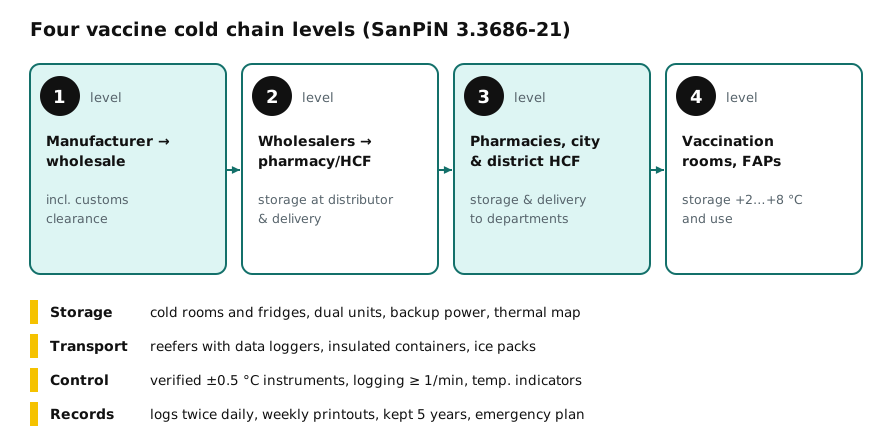
| Level | Participants |
|---|---|
| 1 | delivery of immunobiological products from the manufacturer to wholesale organizations, including customs clearance |
| 2 | storage by wholesale organizations and delivery to other wholesale, pharmacy and healthcare organizations |
| 3 | storage by city and district pharmacy and healthcare organizations, delivery to their units, retail sale |
| 4 | storage in healthcare facilities and units where immunization is carried out or immunobiological products are used |
Temperature conditions
- Transportation and storage conditions are determined by the product's instructions for use.
- At the fourth level, all immunobiological products, including diluents, are stored in a refrigerator at +2…+8 °C inclusive.
- Freezing of adsorbed products with adjuvants and of diluents is not permitted — for example, DTP and DT vaccines, hepatitis A and B vaccines, and inactivated polio vaccine.
Storage equipment
| Requirement | Essence |
|---|---|
| Temperature map | the temperature stability of the equipment is confirmed by the manufacturer's temperature map or by a temperature mapping report prepared by the owner; its data are taken into account when placing immunobiological products |
| Backup power | stable voltage, backup circuits or automatic switchover to a generator or batteries |
| Premises | heated; in basements — evacuation routes for the products and flood protection |
| Cold room | no windows, insulated door at least 70 cm wide, opening outward, lockable and openable from the inside; temperature alarm |
| Refrigeration units | new cold rooms have a dual refrigeration unit with automatic switchover |
| Shelving | the bottom shelf at least 200 mm above the floor; free air circulation |
| Loading | products that must not be frozen, and monitoring instruments, must not be placed in an airflow colder than +2 °C |
| Ice packs | a sufficient stock of frozen ice packs for insulated containers and as an emergency source of cold |
Temperature control
| Instrument | Requirement |
|---|---|
| All measuring instruments | periodic verification under Federal Law No. 102-FZ on ensuring the uniformity of measurements; accuracy no worse than ±0.5 °C; documentation in Russian |
| Thermometers | values recorded at intervals of no more than 1 minute; stand-alone thermometers with a display placed at the coldest and warmest points according to the temperature map |
| Cold room | data logger, built-in and stand-alone thermometers, temperature indicators; sensors around the perimeter at the level of the middle shelves in at least 2 points; stand-alone instruments in at least 3 points: bottom shelf by the back wall, center, near the door |
| Freezer | data logger, temperature indicator, thermometers able to record −25 °C and below; instruments at the warmest point (near the door) and the coldest point |
| Data loggers | recording at least once a minute; falsification and intermediate data loss excluded; connection to a computer; data from cold rooms read out at least once a week |
| Temperature indicators | sampling rate at least once a minute; individual number; unambiguous visual indication; separate thresholds for overheating and freezing |
An automated monitoring system is explicitly permitted: if control is performed by a monitoring system, readings are recorded electronically with archiving. For immunobiological products, the system's recording interval must be set to no more than 1 minute.
Transportation
- By all means of transport other than refrigerated trucks, immunobiological products are carried in insulated containers; if the journey takes more than an hour, each insulated container is fitted with a temperature indicator.
- The insulated container is pre-cooled to +2…+8 °C before loading; dry ice is prohibited in passive insulated containers.
- When products that must not be frozen are shipped together, conditioned water packs or ice packs with an operating temperature of +2…+8 °C are used.
- The monitoring device is placed between the packages at the location recommended by the container's temperature map; readings are taken on unloading.
- Refrigerated truck: refrigeration and heating unit, thermometer and data logger, temperature display in the cab, insulating curtain; loading into a cargo body brought to +2…+8 °C in advance.
- The supplier informs the recipient in advance of the type of temperature indicator or data logger and confirms that the recipient is able to read it out.
Logbooks and archive
| Record | Frequency |
|---|---|
| Readings of thermometers and temperature indicators in storage equipment (Appendix 39) | levels 1–3: daily, twice a day; level 4: on working days |
| Receipt and dispatch of immunobiological products with temperature indicator readings and numbers (Appendix 40) | at each receipt and dispatch |
| Power outages, breakdowns, temperature excursions | with date and time in the temperature logbook |
| Electronic copy or printout of data logger data | at least once a week, after each transportation stage and in the event of an emergency; retained for 5 years |
| Staff briefing | annually, recorded in the logbook |
Emergency plan
Every organization that transports, stores or uses immunobiological products approves a plan for fire, natural disasters, power outages and refrigeration equipment failure. The plan includes diagrams of the main and backup equipment and of switchover to backup power, calculation of the required number of refrigerators and insulated containers, emergency teams and their duties, notification procedure, transport and contacts. Drills under the plan are held at least once a year.
The actual time a cold room holds +2…+8 °C without power is established by a power-failure test during cold room mapping, and the monitoring system confirms that alarms actually reach the emergency team.
Monitoring instruments
For insulated containers and refrigerators holding immunobiological products, our own recording temperature indicators Smartag are a good fit: accuracy ±0.5 °C, a serial number for the logbook entry, and a configurable interval (1 minute for immunobiological products). The single-use Smartag mini signals an excursion with a light indicator right at receipt. For round-the-clock control of cold rooms with alarms, use the monitoring system.
If freezing is suspected
For vaccines with aluminum-based adjuvants, SanPiN describes the shake test: the test vial is compared with a control vial from the same lot that has been deliberately frozen and thawed. If sediment in the test vial settles as fast as or faster than in the control vial, the vaccine is considered damaged and must be written off.
Frequently asked questions
How many times a day should the temperature of a vaccine refrigerator be recorded?
At the first to third levels of the cold chain, twice a day every day; at the fourth level, on working days. When a monitoring system is used, electronic records with archiving are permitted.
What recording interval does a data logger for immunobiological products need?
No more than 1 minute between consecutive measurements (at least 60 measurements per hour).
Does a vaccine refrigerator need temperature mapping?
The temperature stability of the equipment must be confirmed by the manufacturer's temperature map or by a temperature mapping report prepared by the owner during operation. The temperature map data are taken into account when placing products and monitoring instruments.
How long should data logger data be retained?
Five years at every level of the cold chain.
Can vaccines be transported with dry ice?
The use of dry ice in passive insulated containers during transportation and storage of immunobiological products is prohibited.