Who requires what
| Document | What it regulates | What matters for temperature |
|---|---|---|
| Federal Law No. 61-FZ of 12 April 2010 “On the Circulation of Medicines” | general requirements for the circulation of medicinal products, including veterinary ones | storage and transportation follow the good practice rules that the Russian Ministry of Agriculture approves for veterinary medicinal products |
| Order of the Russian Ministry of Agriculture No. 426 of 29 July 2020 | Rules of Good Storage and Transportation Practice for Veterinary Medicinal Products (registered by the Ministry of Justice on 29 October 2020, No. 60648; in force since 1 January 2021) | equipment for maintaining storage conditions (clause 5), placement of instruments (clause 16), verification and log (clause 17), loading of refrigerators (clause 18), quarantine area (clause 19) |
| Order of the Russian Ministry of Agriculture No. 555 of 21 September 2020 | Rules of Good Pharmacy Practice for Veterinary Medicinal Products | veterinary pharmacies: storage premises and equipment, temperature and humidity control, logs |
| Decree of the Government of the Russian Federation No. 547 of 31 March 2022 | Regulation on Licensing of Pharmaceutical Activities | licenses for veterinary pharmaceutical activities are issued by Rosselkhoznadzor; having monitoring equipment and instruments is a licensing requirement |
Compliance with these rules is checked by Rosselkhoznadzor — both during licensing and in scheduled and unscheduled inspections. Questions about instruments, their verification and logs come up in these inspections as often as they do in Roszdravnadzor inspections of human-medicine pharmacy operations.
What Order No. 426 requires of instruments
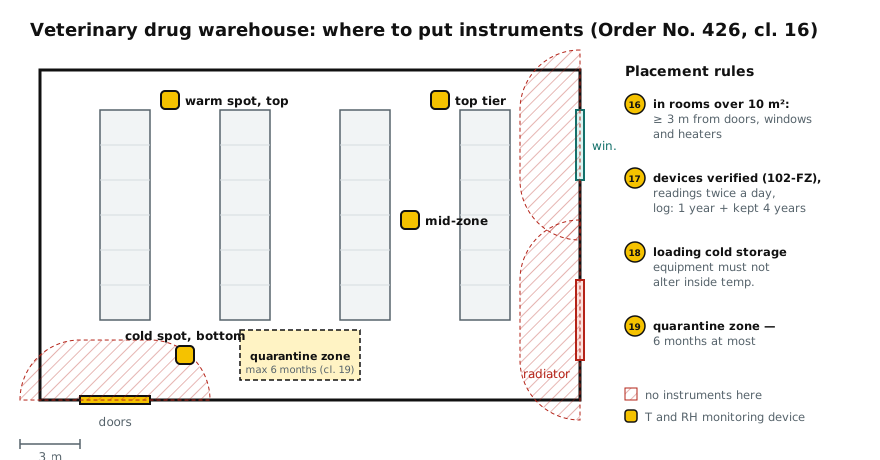
| clause 5 | premises and equipment must ensure the storage conditions specified by the manufacturer: refrigerators, freezers, air conditioning, ventilation |
| clause 16 | in rooms larger than 10 m², temperature and humidity monitoring instruments are placed at least 3 m from doors, windows and heating appliances, at a height convenient for reading |
| clause 17 | instruments must be certified, calibrated and verified in accordance with Federal Law No. 102-FZ “On Ensuring the Uniformity of Measurements”; readings are recorded twice a day in a log (paper or electronic); each log is kept for one year and then retained for four years |
| clause 18 | refrigeration equipment is loaded so that loading does not affect the temperature inside |
| clause 19 | expired, falsified, substandard and counterfeit products are kept in a quarantine area for no more than six months pending destruction or return |
Where the “right” position is. Three meters from a window is a prohibition, not a recommendation of where to place the instrument. The warmest and coldest spots of a warehouse are identified by mapping, and that is where the fixed instruments are moved. This turns the mapping report into the justification for the placement scheme — and that is what you show the inspector.
What it looks like at different facilities
Veterinary medicines distributor warehouse
A +15…+25 °C area with high racking, one or two cold rooms for vaccines and sera, quarantine and a dispatch area. We perform warehouse mapping (7 days, summer and winter) and cold room mapping, and based on the results we install the sensors of the monitoring system: wired RS-485 or LoRa for the racking area, sensors with remote probes in the cold rooms, door and power monitoring. The “twice a day” log is generated automatically from the continuous archive, and the alarm reaches the responsible person before the product has a chance to spoil.
Veterinary pharmacy and clinic
One or two rooms and a few refrigerators. A compact Wi-Fi or GSM system is enough here: a thermohygrometer in the storage room, a sensor in each refrigerator, and an electronic log instead of a paper one. Requirements for veterinary pharmacies are set by Order No. 555 — in substance they are close to the rules for human-medicine pharmacies.
Animal vaccines and biologicals
Immunobiological products for animals are as sensitive to freezing and overheating as those for humans. In transport we use temperature indicators and Smartag data loggers in insulated containers; in storage, sensors are placed at the warm and cold spots of the refrigerator identified by its temperature map. The approach is the same as described on the page on the cold chain for immunobiological medicinal products.
Transportation
Clause 5 of the Order requires storage conditions to be maintained during transportation as well. Refrigerated trucks and insulated containers undergo qualification, and every trip carries a data logger whose report is attached to the batch documents.
What we do, step by step
- Audit and mapping
We inspect the premises, map the storage areas and cold rooms following the EEC Guideline methodology, and identify the warm and cold spots and the areas near dock doors, windows and heating.
- Instrument placement scheme
We prepare a scheme that takes into account the three-meter restriction of clause 16 and the mapping results — it becomes an annex to the storage SOP.
- Monitoring system
We install sensors, set up alarms and notifications, an electronic log with readings recorded twice a day, and an archive covering four years or more.
- Verification and documents
All instruments are measuring instruments of an approved type with valid verification; certificates can be looked up by serial number on the Verification Certificate page.
- Ongoing support
Verification schedule, a pool of replacement loggers, re-mapping when the layout or equipment changes, and help preparing for a Rosselkhoznadzor inspection.
What is about to change
The Russian Ministry of Agriculture is preparing new rules. In July 2026 a draft order “On Approval of the Rules for Storage of Medicinal Products for Veterinary Use” was published (public discussion ran until 7 August 2026); it is planned to be in force from 1 September 2027 to 1 September 2033. In August 2026 a draft new version of the veterinary pharmacy practice rules was published, to be in force from 1 March 2027 to 1 March 2033. If adopted, the drafts will replace Orders No. 426 and No. 555, and references in SOPs and instructions will need to be updated.
A practical tip: do not tie internal documents to clause numbers. Describe the requirement in substance (“instruments outside the zones influenced by doors, windows and heating, placed according to the mapping results”) and reference the current regulation in one place — then a change of order will require only one edit. We track changes in the Regulations section and in our news.
Frequently asked questions
Is mapping required for a veterinary medicines warehouse?
Order No. 426 does not use the word “mapping” explicitly, but it requires instruments to be placed outside the zones influenced by doors, windows and heating, and storage conditions to be maintained throughout the storage volume. Without mapping it is impossible to prove that the conditions are maintained everywhere and that the instrument is in a representative position — which is why both distributors and manufacturers carry it out. For cold rooms, mapping also reveals freezing zones near the evaporator.
Can the log be kept in electronic form only?
Yes. Clause 17 allows the log to be kept on paper or electronically. An electronic log from the monitoring system is more convenient: the twice-daily entries are generated from the continuous archive, they cannot be backdated, and four-year retention is ensured by backups.
How do the veterinary requirements differ from the human-medicine rules of Order No. 260n?
In spirit they are the same: conditions per the manufacturer’s instructions, verified instruments, a log. The differences are in the details: Order No. 426 specifies a distance of 3 m and a recording frequency of twice a day, while the Order No. 260n rules explicitly require monitoring instruments to be placed according to the mapping results. If a warehouse stores both kinds of products, both sets of requirements apply.
Who issues the license, and what is checked during an inspection?
Licenses for pharmaceutical activities involving veterinary medicinal products are issued by Rosselkhoznadzor under the Regulation approved by Government Decree No. 547. Inspectors look at the premises and equipment, the instruments and their verification, the logs, the procedure for the quarantine area and the transport conditions.