How a 3PL warehouse differs from an in-house one
Third-party storage of medicinal products is a licensed pharmaceutical activity: the Regulation approved by Decree of the Government of the Russian Federation No. 547 of 31 March 2022 requires a license for the storage of medicinal products, and therefore premises, equipment and instruments that comply with the storage rules. The warehouse is subject to the EAEU Rules of Good Distribution Practice (EEC Council Decision No. 80) and the Rules for Storage of Medicinal Products, Order No. 260n: initial mapping before the premises are put into use, placement of monitoring instruments according to its results, daily temperature and humidity monitoring, verified measuring instruments, and investigation of deviations.
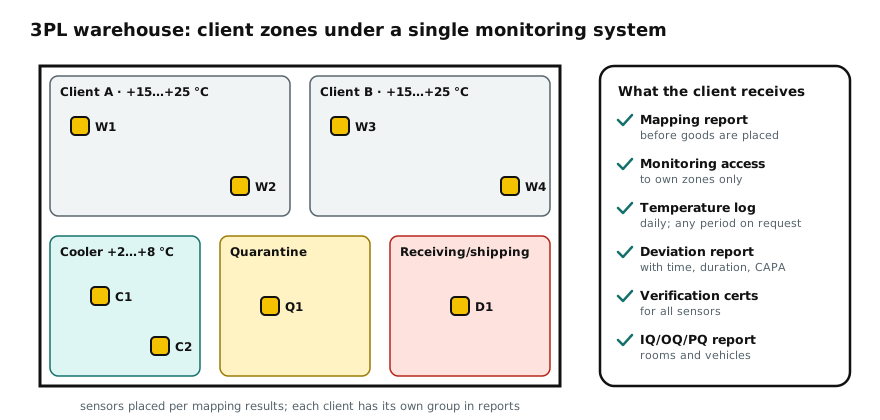
The difference lies in who asks the questions. An in-house warehouse has one quality department; a 3PL provider has as many as it has clients, each with its own audit, its own list of documents and its own idea of what a “normal” report looks like. Monitoring in such a warehouse must be partitionable: one system, but each client has its own zone, its own sensors, its own reports and its own access.
What the client’s auditor checks and how to answer
| Auditor’s question | Our answer | Where it comes from |
|---|---|---|
| Have the premises been mapped, and when was mapping repeated? | mapping report with summer and winter temperature maps, logger position layout, conclusions; re-mapping schedule | warehouse mapping , re-mapping |
| Why are the sensors placed exactly here? | placement scheme linked to the warm and cold spots identified in the report | clause 18 of the Order No. 260n rules, EEC mapping guideline |
| How is my zone monitored? | extract for the client’s sensor group: readings, alarms, reports for the period | “client” role in the monitoring system, access only to the client’s own zones |
| Were there any deviations, and what was done? | deviation report: time, duration, actual values, actions, impact assessment, CAPA | CAPA management |
| Are the instruments verified? | verification certificates for each sensor in the zone, records in FSIS Arshin | lookup by serial number , verification schedule |
| Is the monitoring system validated? | validation package: URS, IQ/OQ/PQ, audit trail, access control | monitoring system validation |
| How is transport controlled? | qualification reports for refrigerated trucks and insulated containers, data logger reports for each trip | transport qualification |
| What happens if equipment fails at night? | alarm escalation routes, cold room hold-over times from qualification, response procedure | cold room qualification, notification setup |
How we build monitoring in a 3PL warehouse
- Mapping the entire warehouse
All storage areas, cold rooms and freezers — over two seasons, following the EEC Guideline methodology. The report is prepared so that it can be shown to any client: without other clients’ data, with conclusions for each zone.
- Zone and sensor layout
Sensors are placed according to the mapping results; each zone is assigned to a client. When a client moves to another zone, the layout is updated and the history is preserved.
- Role-based system
The operator sees the whole warehouse, a client sees only its own zones and reports; the client’s auditor receives temporary access for the duration of the audit. The audit trail records who viewed or changed what.
- Reports and deviations
The daily temperature and humidity log is generated automatically; deviation reports are compiled separately for each zone and sent to the client within the agreed time.
- Verification, replacement pool, re-mapping
A verification schedule for all sensors, replacement without interrupting monitoring, and re-mapping when racking or equipment changes or after a serious deviation.
What to put in the contract with the client
Disputes at 3PL warehouses almost always come down to something the contract did not cover. It helps to agree in advance on:
- storage conditions by zone and acceptable short-term excursions (for example, during goods receipt);
- the retention period for monitoring data and the export format when the contract ends;
- how quickly the client is notified of a deviation and what the report contains;
- how the client’s auditor gets access to the system and the premises;
- who is responsible for verifying the sensors in the client’s zone and for re-mapping when the client moves.
With such a system, a client audit turns from a last-minute scramble into an export of ready-made documents: mapping reports, layouts, logs and certificates are kept in one place and linked to a specific zone.
Frequently asked questions
Does mapping need to be repeated when a new client moves into a zone?
If the layout, racking and equipment have not changed, the current report and sensor layout are sufficient: the report describes the premises, not the goods. Re-mapping is needed when the layout changes, equipment is replaced, or after deviations showing that the temperature distribution has changed.
Can a client receive alarms directly?
Yes. A separate recipient group is set up in the system for the client’s zone, so the client’s quality person receives the alarm at the same time as the warehouse staff on duty. Thresholds and routes are agreed in the contract.
How can data be shown to an auditor without disclosing other clients?
Reports are generated for the zone’s sensor group, and the auditor’s access is limited by role. In the mapping report, data for other zones is anonymized or excluded.
How long should the monitoring archive be kept?
The rules require storage records to be kept for no less than the period established for documents on the circulation of medicinal products; for a pharmaceutical warehouse, common practice is at least five years, and the client contract may set a longer period. The system keeps the archive without limit, and backups are made automatically.