Equipment we map
| Type | Typical range | What is stored | Mapping specifics |
|---|---|---|---|
| Freezer rooms | −25…−18 °C | active substances, plasma, certain vaccines and products as per their regulatory documentation | grid based on room dimensions, frost and defrosts, doors with air curtains |
| Upright and chest freezers | −20…−40 °C | biological material, reagents, medicinal products | 9 points; chest freezers are colder at the bottom and warmer under the lid |
| Ultra-low temperature freezers | −70…−86 °C | mRNA products, cell-based products, samples | external probes, long recovery, hold-over test |
| Dry ice and liquid nitrogen containers | −78 °C and below | transport and temporary storage | qualification against a time profile, see the transport section |
The specific range is always taken from the product’s quality specification or the manufacturer’s instructions. For samples and reagents, it comes from the laboratory’s requirements.
Equipment for deep cold
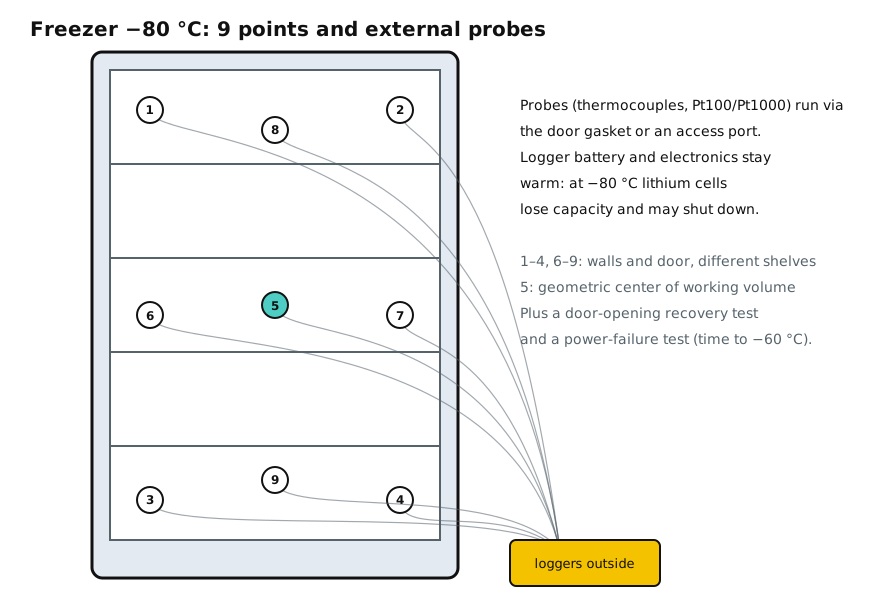
The lithium batteries and electronics of most loggers are not designed for prolonged operation at −80 °C. That is why ultra-low temperatures call for loggers with external probes: the device itself stays outside, while thin cables with thermocouples or Pt100/Pt1000 resistance thermometers are routed through an access port or the door seal.
- The logger’s measuring range must cover the operating range and possible spikes with a margin.
- Accuracy of ±0.5 °C or better within the acceptance criteria; we check that verification covers the relevant range.
- Cables are routed so as not to compromise the seal: otherwise the mapping itself will create heat ingress and frost.
- For freezer rooms down to −30 °C we use Smartag temperature indicators, as this is the lower limit of their measuring range; for lower temperatures we use external probes.
Tests
Steady state
Minimum, maximum and mean temperature at each point with the door closed, cycle amplitude and, in freezer rooms, the effect of defrosts.
Recovery after door opening
The door is opened for a set time, for example 60 seconds, and we record how many minutes it takes for all points to return to range. In ultra-low temperature freezers, recovery to −70 °C can take tens of minutes, which must be factored into the sample handling procedure.
Hold-over time during power failure
Power is switched off and the time until the first point exceeds the upper limit is recorded. The result determines how quickly the alarm must trigger and how much time is available to move the contents to a backup freezer.
How to place products based on the results
- Keep the most sensitive samples in the central area, where the mean value is most stable.
- By the door and on the top shelf of a cabinet, keep items that tolerate brief warming better.
- Do not overload the volume: packed shelves impair circulation and increase recovery time.
- For freezers holding particularly valuable products, install a monitoring sensor with an external probe at the warmest spot and set alarms for both limit excursions and their duration.
Frequently asked questions
Can a standard logger be used at −80 °C?
As a rule, no: the batteries and electronics are not designed for such temperatures. Loggers with external probes are used, while the device itself stays outside.
How many points are needed for a freezer cabinet?
Usually 9: the corners of the working volume on different shelves and the center. For freezer rooms, the number is determined by the EEC grid based on the dimensions.
How long does freezer mapping take?
As with cold rooms, 24 to 72 hours, plus time for the recovery and power-failure tests.
Will the probes damage the door seal?
Thin probes are routed through an access port or, if there is none, via a flat cable through the seal. After the study, we check that the door still closes tightly.
What if a freezer fails the criteria?
The report will state the cause: overloading, a faulty seal, the installation location or incorrect defrost settings. After corrective actions, a repeat study is carried out.