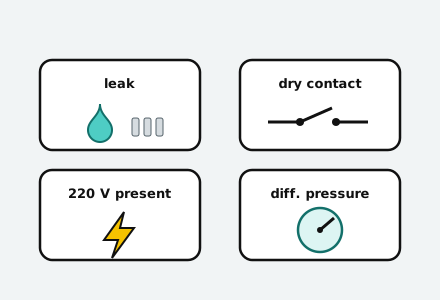
Water leak sensor
It trips when water bridges the contacts of the sensing element on the floor. It is installed where a leak would damage product or stop equipment first and would otherwise go unnoticed for a long time: under cooling units and evaporators, next to drain pans, in ventilation plant rooms, server and equipment rooms, and under the hydraulic assemblies of humidification systems.
| Sensing element | remote sensing cable or a spot sensor on the floor |
| Sensing cable length | up to several tens of meters, extendable in sections |
| Output | dry contact to a digital input, or a separate address on the RS-485 line |
| Response time | a few seconds from the moment of contact |
| Power | from the monitoring system line, backed up by the cabinet UPS |
| Optional | can control a motorized water shut-off valve |
A leak under a cooling unit often means more than water on the floor: it may be the start of a failure, such as a clogged drain or an evaporator icing up. That is why it makes sense to route the leak signal not as a “cleaning” task but as a technical alarm with its own recipient.
Dry contact input
This is not a measuring instrument but a way to bring a ready-made signal from third-party equipment into the system: a cooling unit, an automation panel, the fire alarm, a UPS, a cold room door. Most industrial devices have an “alarm” or “running” relay output, and that is what gets connected.
| What is connected | What the system shows | Why |
|---|---|---|
| cooling unit alarm relay | “Cooling unit: alarm” with a timestamp | it is clear why the temperature started to drift |
| cold room door limit switch | duration and number of door openings | explains temperature spikes and keeps staff disciplined |
| compressor “running” relay | operating hours and number of starts | early detection of wear |
| UPS “on battery” output | switchover to backup power | time to act before the batteries run down |
| fire alarm output | event in the common log | a single picture of the whole site |
| manual call button | “staff call” event | records of abnormal situations |
| Input type | digital, normally open or normally closed, configurable |
| Number of inputs | 2 to 16 inputs per module, modules can be added |
| Galvanic isolation | yes, so that a fault in a third-party panel cannot damage the system |
| Debounce filter | configurable, to avoid spurious events |
| Behavior | alarm on activation and on the duration of a state |
220 V power presence sensor
It checks whether power is present on a specific phase or line: at the cold room supply, on the socket circuit feeding a medical refrigerator, in the distribution board of a frozen storage warehouse. The system will notice a general power outage anyway, because the sensors go silent, but a power presence sensor answers a more precise question: exactly where the power was lost and when it came back.
| Monitored voltage | AC 220 V (single-phase version) or 380 V (three-phase version) |
| Trip threshold | configurable, typically 150–180 V |
| Galvanic isolation | mandatory: the power circuit is separated from the data line |
| Output | dry contact or an address on the RS-485 line |
| Installation | DIN rail in the distribution board, performed by a qualified electrician |
| Alarm | instant, with the time of loss and restoration recorded |
Important for the cold chain. A power loss is recorded as an event in its own right, not only as the temperature rise that follows. This is exactly what is asked when a deviation is investigated: when the power was lost, how long the outage lasted, what the temperature did during that time and who was notified.
Pressure sensors
Monitoring systems use two different instruments, and they should not be confused.
| Type | What it measures | Where it is used | Typical range |
|---|---|---|---|
| Differential pressure sensor | the pressure difference between two rooms, or upstream and downstream of a filter | cleanrooms, airlocks, operating rooms, isolation boxes, isolators | 0…±100 Pa and 0…±250 Pa |
| Absolute pressure sensor | barometric pressure in the room | laboratories, climatic chambers, test areas | 80…110 kPa |
| Accuracy (differential pressure) | typically ±(1…2) % of the upper measurement limit |
| Connection | two impulse tubes through bulkhead fittings in the wall |
| Output | RS-485 Modbus RTU, analog 4–20 mA or 0–10 V |
| Display | versions with a display for installation in the room |
| Metrology | measuring instrument of an approved type with valid verification |
| Role in the system | continuous recording of the value and an alarm if the cascade is disrupted |
How a pressure cascade is designed and what the regulations require is covered in detail on the Cleanrooms page.
Particle counter
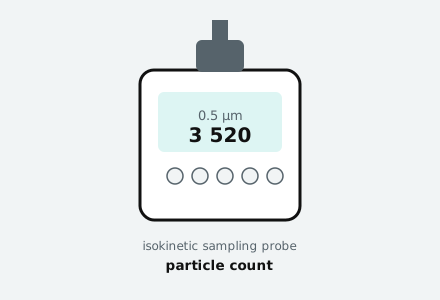
A particle counter is the measuring instrument used to confirm the air cleanliness class under GOST R ISO 14644-1-2017. It draws a known volume of air through an optical chamber and counts the particles, sorting them by size.
| Version | How it is used | When it is chosen |
|---|---|---|
| Portable counter | qualification and periodic monitoring at sampling points, with results entered in the protocol | room classification, routine monitoring, deviation investigations |
| Fixed counter with continuous sampling | continuous monitoring of a critical zone, with data sent to the monitoring system | Grade A and B zones, filling, aseptic assembly |
| Multi-point manifold | a single counter polls several sampling points in sequence | several critical points on a limited budget |
| Particle sizes | at least 0.5 and 5.0 µm, the sizes used to classify rooms |
| Flow rate | typically 28.3 L/min (1 ft³/min in non-Russian datasheets); the rated flow rate matters for classification |
| Sampling probe | isokinetic probe facing into the airflow |
| Data output | display, printed report, transfer to the monitoring system |
| Metrology | approved type and valid verification; without them the result will not be accepted |
| Sampling | the sample volume and number of locations are calculated per GOST R ISO 14644-1-2017 |
How these sensors work together
- Event
Power is lost at the cold room supply. The 220 V sensor records the moment.
- Alarm
The system immediately notifies the person on duty: on screen, with a sound, in the mobile app and through the selected channels.
- Context
The archive shows alongside it that the cooling unit raised an alarm, the cold room door was not opened and the temperature is still in range, so there is time to act.
- Decision
Staff follow the procedure: backup power, moving the product, calling the service team.
- Review
The report includes every event with timestamps and acknowledgements, which is enough to assess the deviation.
What we need to select the equipment
- A list of zones and rooms with their storage conditions or cleanliness classes.
- What needs to be monitored besides temperature: leaks, power, doors, cooling units, pressure, particles.
- Whether the existing equipment has “alarm” and “running” relay outputs.
- The power supply diagram: which supplies and circuits need to be monitored.
- For cleanrooms: the pressure cascade diagram and a list of critical pressure differentials.
Frequently asked questions
How is a dry contact different from a sensor?
A sensor measures a quantity and transmits a number. A dry contact is simply closed or open: a way to receive a ready-made signal from third-party equipment. In the system it appears as a timestamped event rather than as a chart.
Do a leak sensor and a dry contact input require verification?
No. Verification applies to measuring instruments: temperature, humidity and pressure sensors, and particle counters. A leak sensor and a digital input do not measure anything, so they are not subject to verification. Only instruments whose readings you present during inspections are verified.
Can these sensors be added to a system that is already running?
Yes, if the cabinet has free inputs or room for an expansion module. They are a standard addition to a Hladverk Group system; third-party systems can take them if they support Modbus RTU.
What differential pressure is considered normal in a cleanroom?
The standard value between adjacent rooms of different grades is 10–15 Pa (EAEU Good Manufacturing Practice Rules, Annex 1). The specific values for your facility are set by the design and confirmed during qualification.
Should we buy a particle counter, or can one be brought in for qualification?
It depends on the task. For periodic classification it is usually enough to bring in a verified instrument together with a specialist. Owning a counter makes sense when monitoring is needed frequently or continuously in Grade A and B zones.
How many leak sensors does a cold room need?
The count is based not on floor area but on where water will run first: under the cooling unit, next to the drain, at the lowest point of the floor. A typical cold room needs one or two points, and the sensing cable is laid around the perimeter of the risk zone.