What CAPA is — and what it is not
A common misconception is to treat CAPA as a documentation section. CAPA does involve documents, but they are the result, not the substance. The substance is three actions: find the real cause of the event, eliminate it, and prove that the fix worked. If only the paperwork out of these three steps gets done, you end up with a formality — exactly what regulators issue observations for.
| Not CAPA | CAPA |
|---|---|
| a completed form signed by a manager | a changed process in which the event no longer recurs |
| “additional training was provided” | it has been established why the instruction allowed the error, and the instruction has been changed |
| “root cause: human error”, full stop | human error is justified in writing and a systemic cause has been ruled out (Clause 8.17) |
| the action was closed on time | 3–6 months later, data confirm that the problem has not returned |
| one document per incident | trend analysis: similar incidents are linked to each other (Clause 8.19) |
It helps to distinguish three things that are often written on a single line.
| Correction | dealing with the consequence here and now: quarantining a batch, relocating product, restoring the temperature. It does not address the cause |
| Corrective action | eliminating the root cause of an event that has already occurred, so that it does not happen again |
| Preventive action | eliminating the cause of an event that has not yet occurred but could: the same risk in an adjacent cold room, on another line or in another warehouse |
Inspectors almost always ask: “Show me where the correction is and where the corrective action is.” If the record contains only a correction and the corrective action field says something like “monitoring has been tightened,” the CAPA is considered not closed.
What requires it: current regulations
Since 1 March 2026, the national Rules of Good Manufacturing Practice (Order of the Russian Ministry of Industry and Trade No. 916 of 14 June 2013) no longer apply: manufacturers are inspected and GMP certificates are issued only under the EAEU GMP Rules. Order No. 916 was formally repealed by Order of the Russian Ministry of Industry and Trade No. 3093 of 25 June 2026 (registered with the Ministry of Justice on 28 July 2026, No. 87651). If your SOPs still refer to No. 916, it is time to update those references.
| Document | Where CAPA is addressed | What is required |
|---|---|---|
| EAEU GMP Rules (EEC Council Decision No. 77 of 3 November 2016, as amended 4 July 2023), Chapter 1 “Pharmaceutical Quality System” | Clause 1.4 (xiv) | an appropriate level of root cause analysis is applied when investigating deviations, suspected product defects and other problems; the level is determined using quality risk management principles |
| Ibid., Chapter 1 | Clause 1.6 | periodic reviews of the operation of the quality system with the involvement of senior management — management review |
| Ibid., Chapter 1 | Clauses 1.10–1.11 | product quality review; its results are used to evaluate whether corrective and preventive actions or revalidation are needed, with the reasons documented and the actions completed in a timely and effective manner |
| Ibid., Chapter 8 “Complaints, Quality Defects and Product Recalls” | Clauses 8.16–8.19 | root cause analysis; written justification of any conclusion of human error; identification and implementation of CAPA with mandatory monitoring and assessment of effectiveness; regular review of records for recurring problems |
| Ibid., Chapter 9 “Self-Inspection” | Clauses 9.1–9.3 | a scheduled self-inspection program, conducted independently, with observations and proposed corrective actions documented |
| Ibid., Chapter 6 “Quality Control” | Clauses 6.9, 6.16, 6.35 | data are recorded in a way that allows trend evaluation; out-of-specification and out-of-trend data are reviewed and referred for investigation |
| Ibid., Part III, Chapters II and III | — | harmonized texts on quality risk management (equivalent to ICH Q9) and the pharmaceutical quality system (equivalent to ICH Q10) are included directly in the Rules: in the EAEU they are not “foreign guidance” but part of a regulatory document |
| EAEU GDP Rules (EEC Council Decision No. 80 of 3 November 2016) | Clause 11 (d) and (e) | deviations from established procedures are documented and investigated; appropriate corrective and preventive actions are taken in line with quality risk management principles |
| Ibid. | Clauses 10, 13–14 | a change management system; a formal process for periodic review of the quality system, with results documented and communicated to staff |
| Ibid. | Clauses 117–120 | self-inspections under a program covering all aspects of GDP; results are documented |
| Annex 11 to the EAEU GMP Rules “Computerised Systems” | Sections 4, 7, 9–14 | validation, backup, audit trail, change management, periodic evaluation, access control, incident management with root cause identification for critical failures, electronic signatures |
| Annex 15 to the EAEU GMP Rules “Qualification and Validation” | — | results that fail to meet acceptance criteria are recorded as deviations; significant changes to a protocol are documented as deviations with scientific justification |
| EEC Board Recommendation No. 25 of 19 September 2023 | — | guidance on data integrity and validation of computerized systems: an audit trail recording “who, what, when and why”, electronic signatures, separate storage of backups |
The 2023 revision ICH Q9(R1) clarified that the formality of risk management is not a binary “present or absent” but a spectrum: a simplified approach is acceptable for simple cases. The text of Part III of the EAEU GMP Rules corresponds to the original version of ICH Q9, so if you work for export it is worth consulting both versions.
The lifecycle of a CAPA record
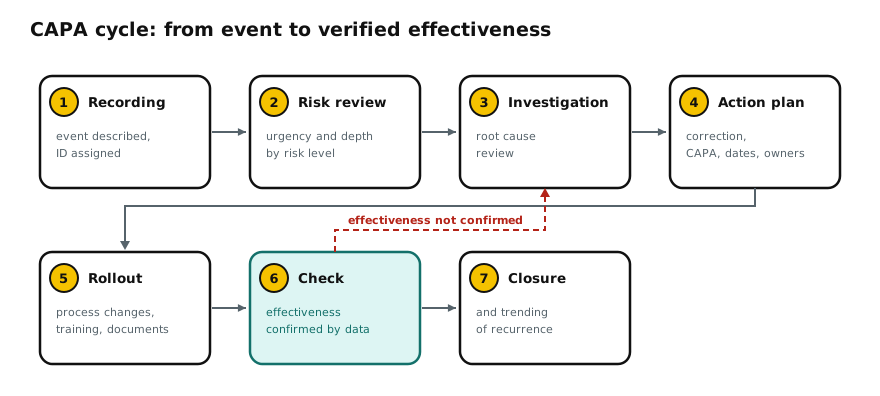
- Registration
— the event is described so that a year later it is clear what happened: the object, time, duration, measured values, and who detected it. A number and a source (deviation, complaint, audit, trend) are assigned.
- Immediate correction
— what was done right away to limit the consequences: quarantining product, moving it to another cold room, calling out service engineers. This is recorded separately from the corrective action.
- Risk assessment
— the impact on product quality and on the patient. Everything that follows depends on this assessment: the depth of the investigation, timelines, the level of approval, and whether the regulator and the marketing authorization holder need to be notified.
- Root cause investigation
— collecting data and checking related batches, equipment, time periods and sites; a formal analysis method; a conclusion supported by facts, not opinion.
- Action plan
— separately: correction, corrective actions, preventive actions. Each has an owner, a due date and a completion criterion. The plan assesses whether an action could create new risks.
- Implementation
— changes to processes, equipment, setpoints and monitoring points; SOP revision; training with confirmation; where necessary, requalification or revalidation through the change management procedure.
- Effectiveness check
— a predefined criterion and observation period. Not “the action has been completed” but “over N months the event has not recurred under comparable conditions.” If the criterion is not met, the record goes back to investigation.
- Closure and trend analysis
— the record is closed and its data feed into the product quality review and management review; recurrence of similar events is tracked separately.
Where inputs come from and where outputs go
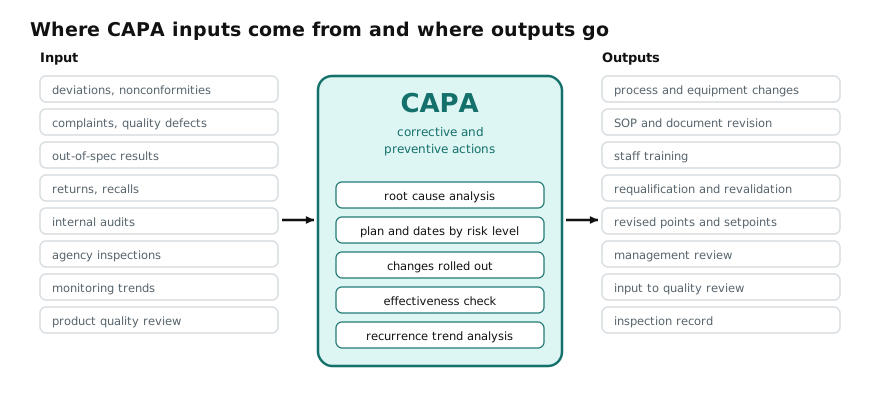
For warehouses, cold rooms and transport, the most frequent input is temperature monitoring data. And inputs are not only alarms but also trends: a slow drift in the average temperature, a growing number of short excursions, longer door-open times. Clause 6.9 of the EAEU GMP Rules explicitly requires data to be kept in a way that allows trends to be evaluated, and values falling outside them to be referred for investigation.
| Input | Typical scenario in a warehouse or cold room | What usually turns out to be the root cause |
|---|---|---|
| Temperature alarm | excursion outside +2…+8 °C at night, lasting 96 minutes | evaporator icing due to a clogged drain; failure of one of two refrigeration units without an alert |
| Trend without an alarm | the zone's average monthly temperature rose from +5.2 to +7.1 °C | seasonal load, a changed loading pattern, degradation of the door seal |
| Prolonged door opening | increase in average door-open time at goods receipt | changed logistics, understaffing at peak times, no airlock/vestibule |
| Power outage | switchover to backup power for 40 minutes | faulty main incoming circuit breaker; expired UPS batteries |
| Consignee complaint | a temperature indicator in an insulated container showed an excursion | insufficient number of cold packs; packing procedure not followed |
| Self-inspection finding | the actual sensor locations do not match the mapping report | the zone was re-arranged without revising the report; no revision procedure |
| Measuring instrument failure | a sensor with an expired verification found during an audit | no register of measuring instruments with due dates; responsibility not assigned |
Root cause analysis: the tools
The Rules do not prescribe a specific method — they require the level of analysis to be commensurate with the risk. In practice several tools are used, and the choice depends on the complexity of the event.
| Method | When appropriate | Limitation |
|---|---|---|
| “Five whys” | simple single events with an obvious chain | easy to follow one branch only and stop at human error |
| Ishikawa (fishbone) diagram | when there may be several causes from different areas | shows hypotheses but does not prove them — data are needed for each branch |
| Fault tree analysis (FTA) | failure of a technical system: refrigeration, power supply, automation | requires understanding of the circuit and time to build |
| Failure mode and effects analysis (FMEA) | preventive actions, design of a new system | labor-intensive; quickly becomes outdated if not updated |
| “Is / is not” comparison (Kepner-Tregoe) | when you need to understand why the problem appeared here and not there | requires comparable objects for comparison |
| Statistical trend analysis | slow changes, recurring minor events | requires long data series and a correct sample |
Chapter 8 of the EAEU GMP Rules specifically addresses cases where human error is named as the cause: such a conclusion must be formally justified so that process or systemic causes are not overlooked (Clause 8.17). This is the most common point at which an investigation is judged superficial.
Risk determines depth and timelines
Investigating every event in equal detail is neither possible nor necessary. The core principle of quality risk management is that the level of effort, formality and documentation is commensurate with the level of risk. In practice, this means you need a matrix that assigns each event to a category, and the category sets the timeline and procedure.
| Category | Example | Depth of investigation | Typical timeline |
|---|---|---|---|
| Critical | excursion from storage conditions with a likely impact on batch quality; falsified product; recall | full investigation using a formal method, involving the qualified person, notifying the regulator where required | immediately; investigation within days |
| Major | recurring deviation without confirmed impact on product | formal root cause analysis, checking related sites and time periods | usually up to 30 days |
| Minor | a single short excursion within limits justified by stability studies | simplified review with a record and monitoring for recurrence | usually up to 30 days, simplified procedure |
The timelines in the table are a guide based on practice, not a regulatory requirement: you set the specific values in your own procedure and then report against it. What matters is that the timeline is set, justified and met: inspectors record overdue CAPAs as a separate finding.
The effectiveness check — the most frequently skipped step
Clause 8.18 of the EAEU GMP Rules states it plainly: the effectiveness of corrective and preventive actions should be monitored and assessed. To make this feasible, the criterion is set in advance — before implementation, not after.
| Criterion | measurable and recorded in advance: “no excursions above +8 °C in cold room K-3 over 6 months at comparable load” |
| Observation period | long enough to cover the conditions under which the event occurred: season, peak load, maintenance cycle |
| Data source | the monitoring system archive, event log, reports — not verbal confirmation from the person who did the work |
| Who verifies | not the person who implemented the action |
| If the criterion is not met | the record is not closed but goes back to investigation: the root cause was identified incorrectly |
Metrics that management reviews
Management review (Clause 1.6) is meaningless without numbers. The minimum set worth calculating automatically:
| Metric | What it tells you | Warning sign |
|---|---|---|
| Number of open CAPAs | current workload on the quality system | steady growth without closures |
| Share of overdue CAPAs | whether the set timelines are achievable | delays of tens or hundreds of days |
| Average time from event to registration | whether detection works | events are registered only before an audit |
| Average investigation time | whether resources are sufficient | a spike after staff changes |
| Share of CAPAs with confirmed effectiveness | quality of investigations | lower than the share of “closed” CAPAs |
| Recurrence by site and event type | whether the real causes have been eliminated | one site generates several CAPAs a year |
| Share of events attributed to human error | depth of analysis | a consistently high share |
Typical inspector observations on CAPA
For a Russian manufacturer or distributor, the benchmark is the observations of inspectors from SID & GP (the State Institute of Drugs and Good Practices) and Roszdravnadzor (Federal Service for Surveillance in Healthcare): most of them concern the quality system, that is, investigations, justification of causes and CAPA effectiveness. We cite the wording of foreign inspectorates for reference only — these documents do not apply in Russia, but they are published in detail, show clearly what is considered a weak investigation, and follow the same logic as the EAEU GMP requirements.
- Investigations without a scientific justification of the root cause. A typical FDA (US) wording: out-of-specification investigations were found inadequate because they lacked a scientific justification for the root cause determination.
- Ineffective CAPAs. The problem keeps recurring after the CAPA is “closed” — this is regarded as proof that the actions were not effective.
- Overdue CAPAs and deviations closed without corrective actions. A published trend analysis by the UK inspectorate MHRA cites delays of 59 to 242 days and 134 deviations processed without appropriate corrective actions.
- Formal management review: no formal review process, no systematic tracking of actions, review frequency not linked to risk.
- Failure to investigate deviations thoroughly — one of the most frequent observations of foreign medicines inspectors overall; in EAEU GMP terms, this is a breach of Clause 1.4 (xiv) and Chapter 8.
- A gap between the investigation and the data. The report contains a conclusion but no reference to the archive that would allow it to be verified, or the archive cannot reconstruct what happened: the recording interval is too long, there is no event log, or data have been changed without a trace.
Requirements for the system that holds the records
If CAPA is managed electronically — as it is at any site with a monitoring system — the system falls under Annex 11 to the EAEU GMP Rules and EEC Board Recommendation No. 25. The requirements are the same for our module and for any third-party one.
| Validation | the system is qualified and validated for its specific intended use, with IQ, OQ and PQ protocols |
| Audit trail | all significant changes and deletions are recorded: who, what, when and why; the trail is accessible and cannot be disabled by users |
| Access control | physical and logical controls, roles, personal user accounts, no shared passwords |
| Electronic signature | the signature is permanently linked to the record and includes the name, date, time and meaning of the signature |
| Backup | regular, with restore testing; copies are stored separately from the main system |
| Change management | changes to the system and its configuration are made only under a procedure, with an impact assessment |
| Periodic evaluation | confirmation that the system remains in a validated state |
| Incident management | failures are recorded and assessed; for critical ones, the root cause is determined |
| Data integrity | original data cannot be altered; the retention period complies with your procedures |
What we do in this work, and what we do not
To be clear: developing the pharmaceutical quality system, writing deviation management SOPs and conducting investigations is the job of your quality unit or a specialist consultant. We cover the technical side — without which an investigation hits a wall of missing data.
| Task | Our role |
|---|---|
| Reliable data that can actually be investigated | a monitoring system with verified measuring instruments, an appropriate recording interval and a tamper-proof archive |
| An event is noticed on time, not a month later | alarms with escalation, operator acknowledgment, an event log, monitoring of doors, power supply and leaks |
| It is clear not only “what” but also “why” | alarm and pressure sensors : refrigeration unit failure, 220 V power loss, door openings — in the same archive as temperature |
| Trends are visible before a deviation occurs | reports and trend analysis by zone and site, data export for the product quality review |
| The CAPA record is linked to the data that triggered it | a CAPA module in the monitoring system: stages, due dates, owners, audit trail |
| The system is fit for inspection | computerized system validation , IQ, OQ, PQ qualification , a full set of protocols |
| Monitoring points are justified | temperature mapping and revision of sensor placement when things change |
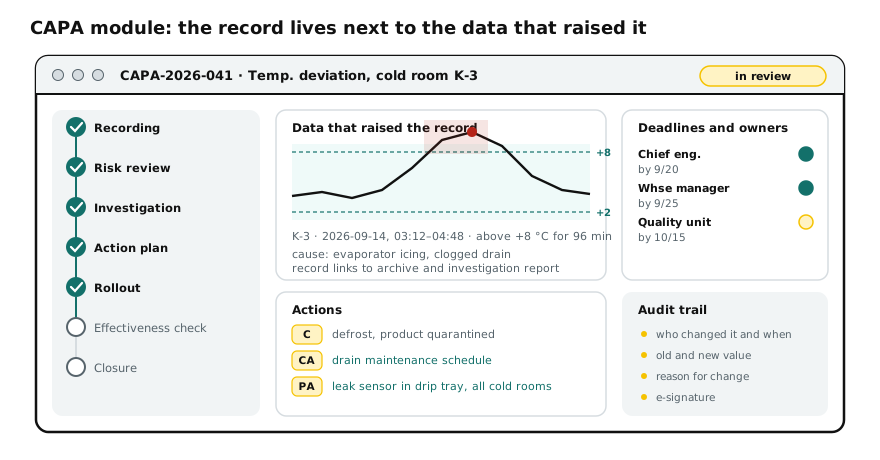
For more about the module and how to get it, see the CAPA module for Rapid SCADA. Our other software and guides are collected in the software and guides section.
The module does not make an organization GMP- or GDP-compliant on its own. It stores records and links them to data — decisions about what counts as the root cause and which action is sufficient are made by people, following your procedures.