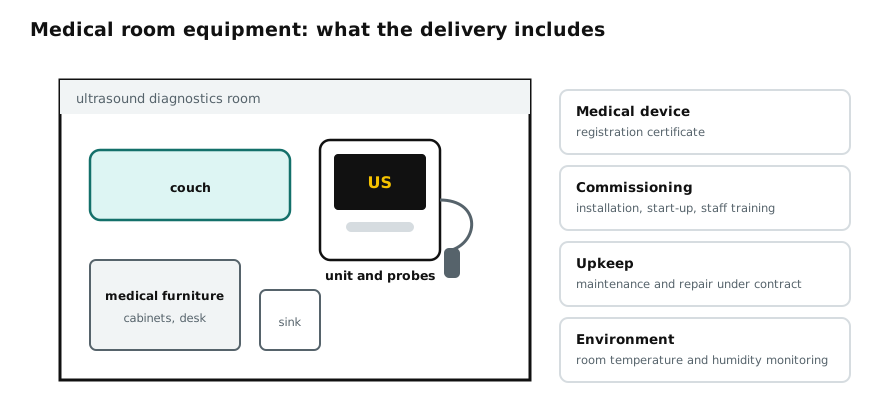
What we supply
Below are the equipment groups for which we most often put together specifications. Specific models are selected for the task, the room size, licensing requirements and the budget: the same examination can be covered by an entry-level or an expert-class device, and the price difference can be several-fold.
| Group | What it includes | Where it is used |
|---|---|---|
| Ultrasound diagnostics | stationary and portable scanners, transducers (convex, linear, sector, endocavity), carts, gels, consumables | ultrasound rooms, obstetrics and gynecology, cardiology, surgery, intensive care units |
| Functional diagnostics | electrocardiographs, 24-hour ECG and blood pressure monitors, spirometers, rheographs | functional diagnostics rooms, general practice appointments, medical check-ups |
| Consulting room equipment | examination couches, screens, scales, stadiometers, blood pressure monitors, pulse oximeters, X-ray film viewers, UV air recirculators | specialist consulting rooms, examination rooms, pre-medical screening rooms |
| Treatment and vaccination rooms | procedure tables, IV stands, instrument trolleys, containers for Class A and B medical waste, emergency kits | treatment rooms, vaccination rooms, dressing rooms |
| Refrigeration equipment | pharmaceutical refrigerators and freezers, vaccine refrigerators, insulated containers, ice packs | hospital pharmacies, vaccination rooms, laboratories, medicine storage warehouses |
| Sterilization and disinfection | autoclaves, dry heat sterilizers, ultrasonic cleaners, sterile instrument storage cabinets | central sterile services departments, dentistry, surgical and treatment rooms |
| Laboratory equipment | centrifuges, incubators, microscopes, analyzers, pipettes, laboratory furniture | clinical diagnostic laboratories, bacteriology laboratories, blood collection points |
| Medical furniture | medicine and instrument cabinets, physician desks, safes for controlled substances subject to quantitative accounting, stretchers | all types of rooms |
| Monitoring and metrology | temperature and humidity monitoring systems, thermohygrometers, data loggers, temperature indicators | refrigerators, pharmacies, laboratories, cleanrooms, transportation |
For every item delivered we provide the medical device registration certificate. A device may be placed on the market in Russia either under a national registration certificate issued by Roszdravnadzor (Federal Service for Surveillance in Healthcare) or under an EAEU registration certificate; national certificates issued earlier remain valid until the end of the period for which they were issued. An item without a valid certificate will not count toward the equipment standard: the licensing authority will not grant a license for that type of work, and during an inspection it will be recorded as a violation.
Fit-out to the standard, not “from a price list”
Fitting out a medical room is not a matter of free choice. Each type of medical care has its own procedure approved by an order of the Russian Ministry of Health, and that order includes an appendix titled “Equipment Standard”. A license for medical activity is granted when the room complies with this standard, and it is this standard that inspectors check against.
| Document | What it sets | Comment |
|---|---|---|
| Order of the Russian Ministry of Health No. 557n of 8 June 2020 | rules for ultrasound examinations, equipment standard for an ultrasound room and department, protocol form | in force since 1 January 2021, registered with the Ministry of Justice on 14 September 2020 under No. 59822 |
| Procedures for providing medical care in specific specialties | equipment standard for a specific specialty: pediatrics, obstetrics and gynecology, cardiology, dentistry, oncology and others | the orders are updated, so before procurement we check the current edition for the customer's specialty |
| Resolution of the Government of the Russian Federation No. 852 of 1 June 2021 | regulation on licensing of medical activity: having equipment in line with the equipment standard is a licensing requirement | checked when a license is issued and during inspections |
| SP 2.1.4284-26 | sanitary and epidemiological requirements for premises, equipment and operating conditions, including those of healthcare facilities | take effect on 1 September 2026, replacing SP 2.1.3678-20, valid until 1 September 2032 |
| SP 158.13330.2014 | design of buildings and premises of healthcare facilities: floor areas, room composition, building services | updated edition with Amendments No. 1–6 |
| Resolution of the Government of the Russian Federation No. 2129 of 30 November 2021 | licensing of maintenance of medical devices | current edition of 17 February 2026; determines who is entitled to service the delivered equipment |
| Federal Law No. 323-FZ of 21 November 2011, Article 38 | definition of a medical device and the requirement for state registration | the basis for checking the registration certificate of every item |
In practice, the sequence is as follows: first the specialty and the list of works and services for which the room is being licensed are defined, then the equipment standard is taken from the corresponding order, and only after that are models selected. Doing it the other way round, buying equipment and then looking for a specialty to fit it, leaves some items redundant while mandatory ones are missing.
Ultrasound scanners: how they are chosen in practice
An ultrasound scanner is usually the most expensive item in the room, and it is where mistakes are most often made: buying the “full configuration” where it is not needed, or saving on transducers without which half of the examinations cannot be performed.
| Device class | entry-level, mid-range, expert, premium; defined not by “power” but by the set of modes and the quality of image reconstruction |
| Form factor | cart-based stationary unit, laptop-style portable unit, handheld wireless transducer with a smartphone |
| Transducers | convex (abdomen, obstetrics), linear (superficial organs, vessels), sector/phased array (echocardiography), endocavity, pediatric microconvex |
| Modes | B, M, color and power Doppler, pulsed-wave and continuous-wave Doppler, tissue harmonic imaging, elastography |
| Specialization | general imaging, obstetrics and gynecology, cardiology, vascular, small parts, intraoperative and interventional guidance |
| Integration | DICOM output to PACS/HIS, network printing of reports, physician workstation |
| Operation | warranty period, availability of replacement transducers, an authorized service provider in the region |
Transducers are a wear item. They get dropped, cables break, and a single transducer can cost up to a third of the price of the scanner. When comparing offers, it makes sense to ask straight away for the price of a separate transducer and its delivery time: this affects the cost of ownership more than the price difference between the scanners themselves.
Temperature control: our core area of work
This is what we do every day, and it is usually the weak spot in a fit-out. Installing a vaccine refrigerator is not enough: you need to prove that the temperature inside stays within range, that someone was notified of any deviation, and that the records of it have been retained.
| Facility | What is required | How we deliver it |
|---|---|---|
| Refrigerator for immunobiological medicinal products (vaccines) | continuous temperature monitoring, two independent measuring instruments, a log, notification when +2…+8 °C is exceeded | sensors in the refrigerator, alarms to phones, archive, verified measuring instruments |
| Pharmacy and warehouse of a healthcare facility | mapping of the room, temperature and humidity monitoring, confirmation of storage conditions | mapping according to a protocol, a fixed monitoring system, reports on inspectors' request |
| Treatment and vaccination rooms | temperature control of insulated containers and ice packs during use and transport | Smartag temperature indicators, standalone data loggers, staff procedures |
| Laboratory | monitoring of incubators, −20 and −80 °C freezers, storage conditions for biological samples | low-temperature sensors, separate alarm thresholds for each point |
| Operating room, intensive care, cleanrooms | temperature, humidity, differential pressure between zones, display of parameters to staff | a monitoring system with entrance displays and a pressure cascade |
More about this area of our work can be found on the pages about the monitoring system, cleanrooms and the cold chain for immunobiological medicinal products.
How a fit-out project runs
- Task and specialty
— we determine which works and services the room is being licensed for, which order sets the equipment standard, and what floor area and layout are actually available.
- Specification
— we compile the list of items: mandatory under the standard, technologically necessary and desirable. We show separately what can be postponed without putting the license at risk.
- Commercial proposal
— prices, delivery times, warranty, commissioning terms. For public-sector customers we prepare the description of the procurement item, taking KTRU catalog items into account, and a justification of the specifications.
- Delivery and installation
— delivery, furniture assembly, equipment installation, connection to power and the network and, where needed, approval of the placement against sanitary requirements.
- Commissioning and training
— start-up, functional checks, staff instruction, handover of operating documentation and registration certificates.
- Metrology and monitoring
— submitting measuring instruments for verification, connecting points to the temperature monitoring system, preparing protocols.
- Service
— scheduled maintenance, repairs, supply of consumables and replacement transducers.
Maintenance of medical devices is a licensed activity (Resolution of the Government of the Russian Federation No. 2129 of 30 November 2021). If maintenance is to be outsourced, the contractor must hold a license for the relevant types of work. Our contract states explicitly which work we carry out ourselves and which we pass on to the manufacturer's authorized service organization.
Working with public-sector and corporate customers
A large share of medical equipment is procured under Federal Laws 44-FZ and 223-FZ, and here mistakes cost more than an unfortunate choice of model: an incorrectly described procurement item leads to a complaint to the FAS (Federal Antimonopoly Service) and missed deadlines.
| Description of the procurement item | specifications without reference to trademarks, with a justification for each requirement |
| KTRU | selecting the item in the Catalog of Goods, Works and Services and filling in the mandatory characteristics |
| Justification of the initial price | commercial proposals, calculation of the initial (maximum) contract price (NMCK) |
| Completeness | checking that the specification covers the equipment standard in full, with no gaps and no redundant items |
| Acceptance documents | registration certificates, passports, commissioning certificates, verification certificates |
| Admission restrictions | taking into account current restrictions and conditions for admission of foreign medical devices when preparing the offer |
Why clients come to us for this
We are not a general dealer in “everything medical”. Our strength lies where supply meets metrology and engineering: refrigeration equipment and proof of storage conditions, environmental monitoring, cleanrooms, low-voltage systems for medical rooms. If all you need is a scanner at the biggest possible discount, a specialized distributor may be a better deal, and we will tell you so directly. If you need to fit out a room or a department so that it passes licensing and inspections and is still working properly three years later, that is our job.
Related services: low-voltage systems for medical rooms (structured cabling, CCTV, access control, fire alarm), equipment qualification (IQ, OQ, PQ), service, verification and calibration after delivery.