What the EEC Guideline requires
The temperature mapping Guideline (EEC Board Recommendation No. 8 of 20.04.2026, applied from 23 May 2026) recommends at least two studies for weather-dependent premises — in the hottest and in the coldest time of the year. The obligation to map a warehouse before use is set by binding acts: item 39 of the EAEU GDP Rules and item 18 of Storage Rules No. 260n. More about the documents — in Regulations.
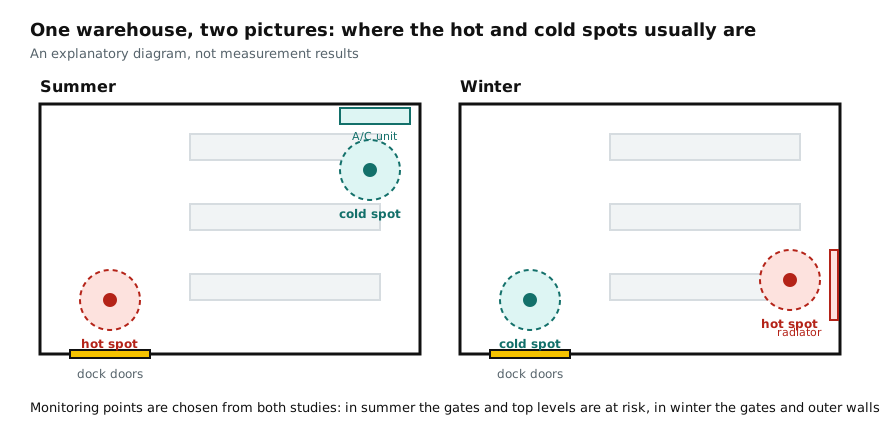
What changes from season to season
| Summer | Winter | |
|---|---|---|
| Main risk | overheating above +25 °C | cooling below +15 °C |
| Where to look | at the dock gates, under the roof, on top levels, at sun-exposed walls and skylights | at the gates and outer walls, in unheated annexes, at the dock |
| What matters | solar load, gate openings, air conditioning | heating, heat loss through the envelope, gate openings |
| Typical conclusion | air conditioning of the upper zone, restrictions near the gates | extra heating, air curtains, no storage at the walls |
How to choose the timing
In central Russia the hot period is usually July and August and the cold one January and February. In the south the summer peak matters more, in Siberia and the Urals the winter one. The best guide is your own monitoring data for the past year: it shows when the area had its highest and lowest values.
- Review a year of monitoring data
Find the weeks with the highest and lowest temperatures in the area and outdoors. If there is no data, go by the regional climate.
- Allow a week plus margin
A warehouse study lasts at least 7 consecutive days to capture working days, nights and weekends. With placement, collection and processing, the whole job usually takes 3–4 weeks.
- Place a logger outdoors
If the area borders the outdoors or an unheated room, one logger is placed outside: without it you cannot tell how hot or cold the study period was.
- Keep the layout
Point numbers and the layout from the summer study are reused in winter and in later years so the results are comparable.
When one season is enough
For re-mapping it is enough to repeat the season in which the initial study and monitoring showed the smaller margin to the limits. Cold rooms and freezers located in a controlled environment usually do not need separate summer and winter studies — the Guideline allows a 24–72 hour study for them. Chambers at outer walls, in unheated annexes or on the dock are better checked with the season in mind.
Commissioning between seasons. If the area has to be used from spring or autumn, the first study is done under current conditions and the seasonal ones in the next hot and cold periods. This plan, its justification and any restrictions until the seasonal studies are recorded in the protocol and risk assessment.
How to compare results
Compare not individual minutes but the mean, minimum and maximum of each point and the margin to the limits. Monitoring points are chosen from both seasons: in summer the top shelf by the gates may be critical, in winter the bottom one at an outer wall. If a monitoring point shows growing amplitude or a shifting mean from year to year, that is a reason for an unscheduled study.
Frequently asked questions
Must a warehouse be mapped in both summer and winter?
For initial mapping of weather-dependent premises the EEC Guideline recommends at least two studies — in the hot and the cold season. The Guideline is a recommendation, but inspectors and auditors compare your procedure with it.
Can re-mapping be limited to one season?
Yes. It is enough to repeat the season in which the margin to the limits was smaller according to the initial study and monitoring. The decision is recorded in the risk assessment.
Does a cold room need summer and winter mapping?
If the chamber is in a controlled environment, usually not. If it borders the outdoors or stands in an unheated room, the seasonal influence is worth checking.
How long does each study last?
A warehouse — at least 7 consecutive days. Cold rooms and freezers — 24 to 72 hours.