The qualification life cycle
Qualification does not start on the day the loggers are placed; it starts with requirements: what will be stored, under what conditions, and which risks are unacceptable. Each requirement is then verified at its own stage, and the results are compiled into a documentation package that is presented during an inspection or audit.
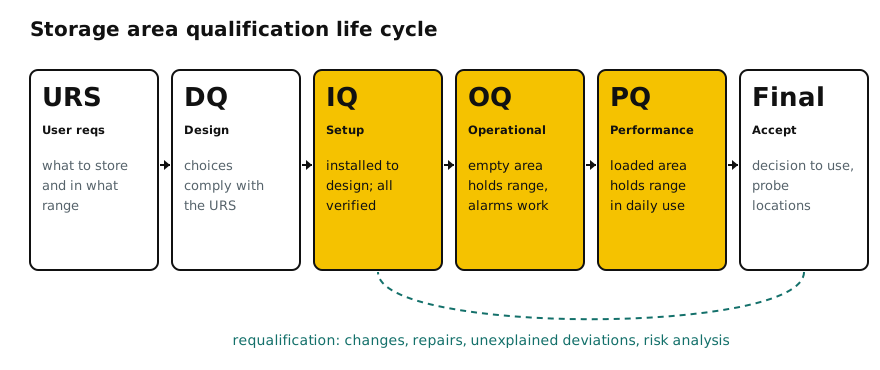
- URS — user requirements specification
Temperature and humidity ranges, storage volumes, product types, requirements for monitoring, alarms, redundancy, power supply and data. This is the reference point for all acceptance criteria.
- DQ — design qualification
Verification that the design solutions meet the requirements: capacity and redundancy of HVAC and refrigeration equipment, location of air diffusers, insulation, monitoring system.
- IQ — installation qualification
Confirmation that what was installed, and how it was installed, matches the design.
- OQ — operational qualification
Testing of systems in the empty area across the entire operating range.
- PQ — performance qualification
Confirmation that conditions are maintained under real load and with staff at work.
- Report and release for use
Final conclusion, approved monitoring points, SOPs and a requalification schedule.
IQ: installation qualification
| What is checked | How |
|---|---|
| Equipment conforms to specification | models, serial numbers, data sheets, certificates |
| Installation per design | as-built documentation, inspection, photos |
| Insulation, doors, seals, air curtains | visual inspection, thermal imaging survey if needed |
| Power supply and backup | connection to a backup line or UPS for monitoring |
| Measuring instruments | verification, records in FSIS Arshin, suitable range |
| Documents | operating manuals, maintenance plan, diagrams |
OQ: operational qualification
The area is empty or holds a minimal simulated load, and the systems run in normal mode. At this stage, temperature mapping of the empty area is performed, along with door-opening and power-failure tests if the protocol provides for them.
- reaching set conditions and stability at all grid points;
- alarm activation for high and low limits and for loss of communication, and delivery of notifications to responsible staff;
- switchover to the standby unit and hold time without power;
- operation of defrost cycles, air curtains and door closers;
- correct recording, storage and export of data by the monitoring system.
PQ: performance qualification
The area is loaded with product or a simulated load, and staff work to their normal schedule. Mapping under operating conditions shows how racks and pallets affect air circulation, as well as actual dock door openings and seasonal conditions. Based on the PQ results, permanent monitoring points and areas where storage is prohibited are approved.
For a warehouse that is already in operation, the EEC guideline allows mapping of loaded areas. In this case OQ and PQ are effectively combined, and the report states that the study was carried out under operating conditions.
Computerized monitoring system
If temperature data is stored electronically, the system itself becomes subject to validation. Practice follows the GAMP 5 approach: software category assessment, verification of access control, record integrity and audit trail, backup and restore, and time synchronization. The storage rules in Order No. 260n explicitly permit an electronic log with archiving.
Documentation package
- requirements specification and risk assessment;
- IQ, OQ and PQ protocols with acceptance criteria;
- temperature mapping protocols and reports;
- verification records for measuring instruments;
- deviation and CAPA records;
- final qualification report with the decision on release for use.
Frequently asked questions
What is the difference between qualification and validation?
Qualification usually refers to confirming that premises and equipment are fit for purpose, while validation confirms that a process or computerized system consistently delivers the required result. In practice, the terms are often used interchangeably.
Can IQ be skipped for an existing warehouse?
For a facility that has been in operation for a long time, full installation qualification is usually replaced by a retrospective assessment: collecting documentation, inspection and checking of measuring instruments. This does not remove the need for mapping and alarm testing.
Who approves the protocols?
Under the EEC guideline, the mapping protocol is approved by the head of the organization or an authorized employee. The report is approved by the person responsible for conducting the mapping.
How often should qualification be repeated?
Based on risk assessment, after significant changes and in case of unexplained deviations. Many organizations include periodic re-mapping in their annual plan.