Versions
| Version | Where it is used | Features |
|---|---|---|
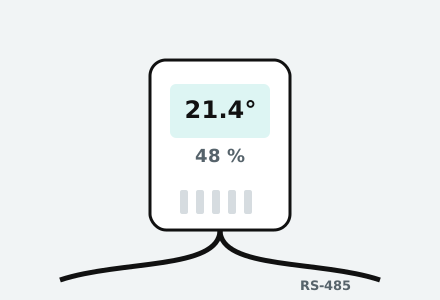
| Thermohygrometer in a housing | warehouses, pharmacy warehouses, receiving and dispatch areas | temperature and humidity, wall mounting, optional display |
| Temperature sensor with a remote probe | cold rooms, display cases, cabinets | electronics outside the room, probe inside; sealed cable entry |
| Sensor with a low-temperature probe | freezer rooms −40…−20 °C, −80 °C freezers | Pt100/Pt1000 resistance thermometers, frost-resistant cable |
| Probe in a product simulator | vaccine refrigerators, rooms with intensive air circulation | smooths out spikes when the door is opened, shows a temperature closer to that of the product |
| Differential pressure sensor | cleanrooms, airlocks | control of the pressure cascade between rooms |
| Barometric pressure and CO₂ sensor | laboratories, production areas | additional parameters on the same line |
| Discrete inputs | cold room doors, refrigeration unit failure, 220 V presence | events in the system alongside temperature |
Typical specifications
| Temperature measurement range (housed sensors) | typically −40…+60 °C |
| Range with remote probes | down to −100 °C and below, depending on the probe type |
| Temperature accuracy | ±0.2…±0.5 °C depending on the model |
| Humidity range | 0…99 % RH |
| Humidity accuracy | as per the type description, usually ±2…±3 % RH in the main range |
| Interface, protocol | RS-485, Modbus RTU |
| Power supply | DC voltage over the line |
| Enclosure protection rating | IP40 for dry rooms, IP65 for cold rooms and wet areas |
| Verification interval | 1–3 years as per the type description |
Installation rules
- Installation points are based on the results of temperature mapping: at the hot spot, at the cold spot if there is a risk of overcooling, and in risk zones.
- The RS-485 line is run with shielded twisted pair in a bus topology with terminators at both ends; stubs are kept as short as possible.
- Sensors must not touch metal structures or sit in the airflow from an air conditioner or evaporator if the goal is to measure the temperature at the product.
- In cold rooms the cable entry is sealed to avoid a cold bridge and condensation.
- The sensor label matches the point name in the software and the layout drawing in the report.
Advantages and limitations
| Advantages | Limitations |
|---|---|
| no battery replacement | cable routes are required and installation takes longer |
| resistance to radio interference from equipment and racking | moving a point requires re-routing the cable |
| sensors are powered from the cabinet UPS, so monitoring continues during a power outage | cable entry is more difficult in cold rooms that are in operation |
Frequently asked questions
How many sensors can be connected to a single line?
The RS-485 standard allows up to 32 unit loads per segment; more with repeaters and low-load transceivers. The number of lines in a system is unlimited: a large warehouse is split into several lines.
Can the sensors be connected to an existing SCADA system?
Yes, if it supports Modbus RTU. We connect these sensors both to the Hladverk Group system and to third-party systems.
What should I choose for a −80 °C freezer?
A sensor with a remote Pt100 or Pt1000 probe: the probe is inside, the electronics are outside.