This article explains how to set up monitoring. For a turnkey solution, see the Hladverk Group monitoring system with hardware, software and validation. For immunobiological medicinal products, SanPiN 3.3686-21 requires a logging interval of no more than 1 minute and data retention for 5 years — see the article on the vaccine cold chain for details.
Manual log or automated system
| Manual log | Automated system | |
|---|---|---|
| Data frequency | 1–2 entries per day | every 1–15 minutes, continuously |
| Nights and weekends | requires a person on duty or a min/max thermometer reading | recorded automatically |
| Deviation | detected at the next round | notification within minutes |
| Evidential value | depends on recording discipline | archive with audit trail |
| Suitable for | a small pharmacy with 1–2 refrigerators | warehouses, chains, healthcare facilities, vaccines |
Order No. 260n recognizes both options: measuring instruments with entries in a log, or an automated 24/7 environmental monitoring system. For warehouses and the cold chain, automation is practically the only option: a unit shutting down at night cannot be noticed manually.
System components
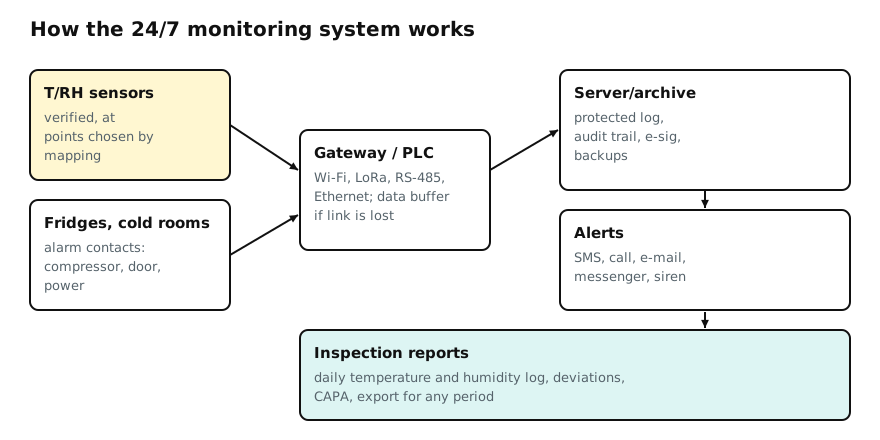
Sensors
Thermohygrometers and thermometers with internal or external probes. Each storage area gets sensors at the points determined by mapping: at the hot spot, at the cold spot if there is a risk of overcooling, and in risk zones such as near dock doors. Sensors must be measuring instruments of an approved type with valid verification.
Data transmission
Wired links (RS-485, Ethernet) are reliable for fixed warehouses. Wireless options (Wi-Fi, LoRaWAN, cellular networks) are easier to install and suit pharmacy refrigerators and vehicles. Buffering is a must: if communication is lost, the sensor stores data and transmits it once the link is restored, so there are no gaps in the archive.
Server and archive
Cloud-based or on-premises. Key requirements: role-based access, no modification of raw data, a user activity log, backups, time synchronization, and archive retention for the period set by the organization's SOP.
Notifications
SMS, voice call, e-mail, messenger, light and sound alarms. A notification must reach a person who can act at night, and escalate if nobody acknowledges the alarm.
How to configure alarms
| Level | Example for +2…+8 °C | Action |
|---|---|---|
| Warning | below +3.0 °C or above +7.0 °C for more than 15 min | check the door, load, refrigeration unit |
| Alarm | below +2.0 °C or above +8.0 °C for more than 5–10 min | emergency procedure, relocation of product |
| Technical | loss of communication, low battery, sensor failure | restore monitoring |
The alarm delay is the most delicate parameter. Mapping shows how much the temperature rises at the sensor location during a typical door opening and how many minutes the room takes to recover. If an alarm goes off with every shipment, people start ignoring it; if the delay is too long, a real failure is missed.
Humidity
Under Order No. 260n, unless the manufacturer specifies otherwise, the relative humidity in storage rooms must not exceed 65 %. For moisture-sensitive products labeled “store in a dry place”, General Pharmacopoeia Monograph OFS.1.1.0010 points to a humidity of no more than 50 % at room temperature. Humidity sensors drift more than temperature sensors, so their verification and sensing element replacement are scheduled more strictly.
What to do in case of a deviation
- Record the time, values and duration from the system data.
- Eliminate the cause or move the product to a suitable area.
- Quarantine the affected product pending a decision.
- Assess the impact on quality, taking the manufacturer's stability data into account.
- Document the deviation and the corrective and preventive actions.
- If the cause has not been identified, consider re-mapping.
Frequently asked questions
Is an automated monitoring system mandatory?
No. Order No. 260n allows verified measuring instruments with daily log entries, including weekends and public holidays. But for warehouses and refrigeration equipment, an automated system is the only realistic way to cover nights and weekends.
Where should monitoring sensors be placed in a warehouse?
For a wholesale organization, based on mapping results and risk assessment, at the points of the greatest temperature fluctuations. For pharmacies, it makes sense to follow the same logic even if mapping is not mandatory.
Can the temperature log be kept in electronic form only?
Yes. Order No. 260n permits an electronic log with archiving. The system should then be validated: access control, record integrity, backups.
How often should monitoring system sensors be verified?
At the verification interval specified in the type description of the measuring instrument; for thermohygrometers it is usually 1–2 years. Verification records are checked in FSIS Arshin.
What should be done if communication with a sensor is lost?
Configure a technical alarm for loss of communication and use sensors with internal memory that upload the missing data once the link is restored.