What exactly is monitored
The cleanliness class is confirmed by particle counting during qualification. Between qualifications, however, the room is kept in compliance by other parameters, and those are what is monitored continuously.
| Parameter | Why monitor it continuously | What happens if it is breached |
|---|---|---|
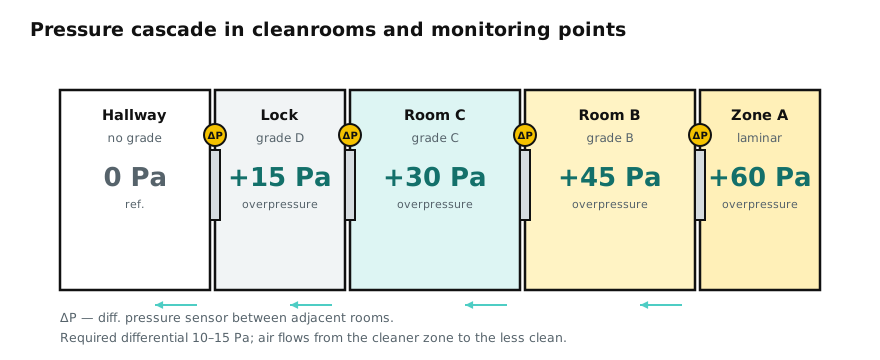
| Differential pressure between zones | it sets the direction of airflow, from the cleaner zone to the less clean one; this is the main barrier against transfer of contamination | air flows the wrong way, and the room loses its protection before particle counts show it |
| Temperature | conditions for the product and the process, comfort of staff in protective clothing | risk to the product, more sweating and therefore more particles shed by staff |
| Relative humidity | product stability, static electricity, microbial growth | when low, static and dust generation; when high, a risk of microbial growth |
| Particle concentration | a direct indicator of the cleanliness class | exceeding the limit means loss of class and an investigation of the batch |
| Door and airlock openings | the pressure cascade is disrupted when doors are opened at the same time | a brief drop in differential pressure that explains a spike on the chart |
Regulations currently in force
The documents below are listed in the editions in force as of September 2026. Some of them were updated in 2025–2026, and this should be taken into account when you revise your own documentation.
| Document | Subject | Status |
|---|---|---|
| GOST R ISO 14644-1-2017 | classification of air cleanliness by particle concentration: ISO Classes 1–9, sampling procedure and calculation of the number of sampling locations | in force since 1 December 2018 |
| GOST R ISO 14644-2-2020 | monitoring to provide evidence of continued compliance: monitoring plan, alert and action levels, data retention | in force since 1 December 2020 |
| GOST R ISO 14644-3-2020 | test methods, including differential pressure testing and filter integrity testing | in force since 1 September 2021 |
| GOST R ISO 14644-4-2025 | design, construction and start-up | new edition , in force since 1 November 2025, replacing the 2002 version |
| GOST R ISO 14644-5-2026 | operations: a monitoring program with continuous checking of differential pressure, temperature and humidity, sensor maintenance | new edition , in force since 1 July 2026, replacing the 2005 version |
| GOST R 52539-2006 | air cleanliness in healthcare facilities: 10–15 Pa between adjacent rooms, continuous visual or automatic pressure monitoring | in force |
| GOST R 56640-2015 | design and installation of cleanrooms: periodic or continuous monitoring of parameters, alarm on simultaneous door opening | in force |
| EAEU GMP Rules, Annex 1 | manufacture of sterile medicinal products: differential pressure sensors where the differential is critical, regular recording of values, alarm on ventilation failure | in force, edition of 4 July 2023 |
| SP 2.1.4284-26 | sanitary requirements for operating the premises of healthcare facilities: ventilation modes, continuous operation of Class A rooms | new rules , in force since 1 September 2026, replacing SP 2.1.3678-20 |
| SP 158.13330.2014 | design of healthcare facility buildings: indoor air requirements, automation and remote supervision | in force, with Amendments No. 1–6 |
What is changing soon. EEC Council Decision No. 67 of 20 May 2026 set out Annex 1 of the EAEU GMP Rules in a new edition harmonized with Annex 1 of EU GMP. Most of the requirements take effect 180 days after official publication, and certain clauses three years after it. For monitoring, two new provisions are fundamental: critical pressure differentials must be subject to continuous monitoring and recording, and the records must be trended and retained for the life cycle of the system. A Contamination Control Strategy (CCS) becomes mandatory. If you are designing a system now, it makes sense to build it for the new edition from the outset.
Entrance displays: what the regulations say and what practice says
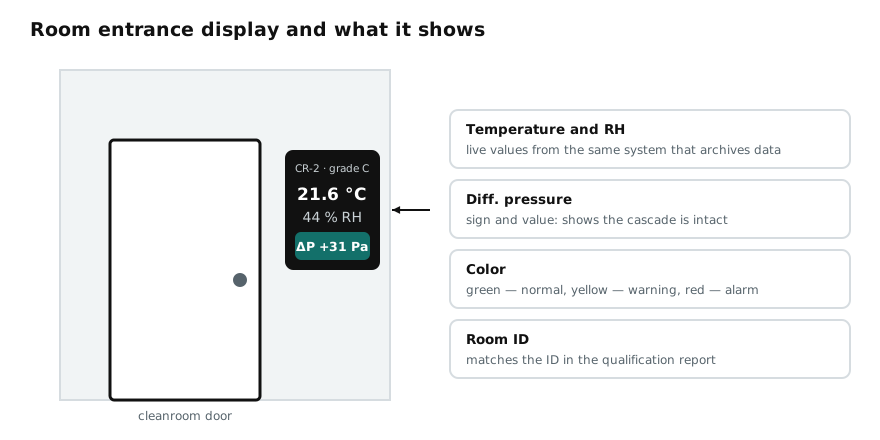
We will answer directly, because the question comes up often: the regulations currently in force contain no direct requirement to install a display with parameters at the entrance to a room. There are, however, requirements from which this practice has grown:
- GOST R 52539-2006 allows “continuous (visual or automatic) monitoring” of differential pressure and makes it mandatory for isolation rooms. The word “visual” means an instrument that can be seen on site.
- EAEU GMP Rules, Annex 1, clause 55 require differential pressure sensors wherever the pressure differential is critical and regular recording of the values, but do not specify where the readout should be located.
- GOST R ISO 14644-5-2026 includes monitoring of differential pressure, temperature and humidity in the operations program.
In practice, an entrance display does something the archive cannot: the person about to enter the room must see that the parameters are in range before stepping inside. That is why we install displays where entering a room with a disrupted cascade creates a risk: at airlocks, operating rooms, aseptic zones and isolation boxes. The decision is documented in the design and in the SOP as your own control measure.
What the system consists of
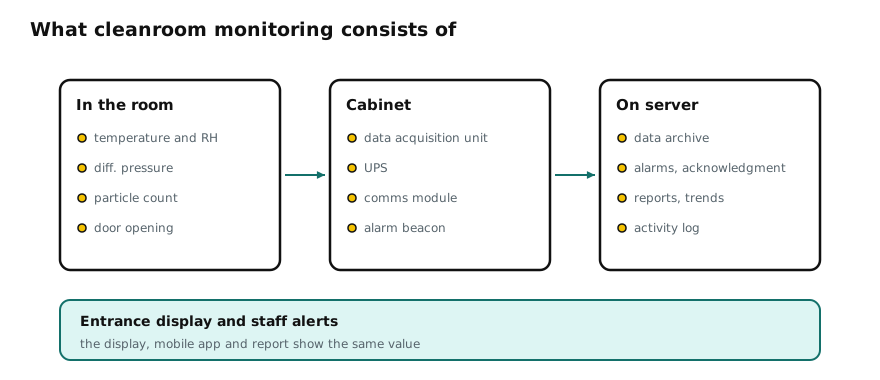
| Differential pressure sensor | differential, 0…±100 Pa or 0…±250 Pa, two impulse tubes through bulkhead fittings |
| Temperature and humidity sensor | cleanroom version: smooth housing with no dust traps, can be wiped down with disinfectant |
| Particle counting | portable counter for periodic monitoring or a fixed counter with continuous sampling in Grade A and B zones |
| Door monitoring | limit switches, interlock preventing simultaneous opening of airlock doors |
| Entrance display | current values, color-coded status, room designation as in the qualification protocol |
| Control cabinet | controller, UPS, input modules, alarm beacon; installed outside the clean zone |
| Server and software | archive, alarms with acknowledgement, reports and trends, user audit trail |
What we do
- Survey and input data
We review the layout, the air handling scheme and the existing automation. Together with you we determine which pressure differentials are critical; this decision affects the entire scope that follows.
- Design
Sensor and display layout, equipment specification, wiring diagrams, cable routes, integration with existing distribution boards. If required, an automation section as part of the design package.
- Installation and commissioning
Installation of sensors and impulse lines, mounting of the cabinet outside the clean zone, cable routing that preserves the airtightness of the room envelope, configuration of controllers, displays and notifications.
- System qualification
IQ, OQ, PQ and computerized system validation: we confirm that the system is installed according to the design, operates according to the specified algorithms and produces reliable data.
- Room qualification
Classification under GOST R ISO 14644-1-2017: particle counting, checks of differential pressure, air change rate and recovery time. A protocol listing the points, the instruments and their verification.
- Ongoing support
Periodic monitoring, verification of measuring instruments, software updates, deviation investigations, inspection readiness. Annual requalification on schedule.
Where it is needed
| Facility | What we monitor | Regulatory basis |
|---|---|---|
| Manufacture of sterile medicinal products | differential pressure across the entire cascade, temperature, humidity, particles in Grade A and B zones | EAEU GMP Rules, Annex 1 |
| Manufacture of non-sterile dosage forms | temperature, humidity, differential pressure between zones of different cleanliness | EAEU GMP Rules, Part I |
| Operating rooms and aseptic areas of healthcare facilities | differential pressure, temperature, humidity, air change rate | GOST R 52539-2006, SP 2.1.4284-26, SP 158.13330.2014 |
| Isolation rooms and boxes in infectious disease wards | differential pressure with mandatory continuous monitoring, door opening alarm | GOST R 52539-2006, clause 5.9 |
| Pharmacies with compounding and aseptic units | environmental conditions, differential pressure, storage condition monitoring | Rules for compounding medicinal products, SanPiN |
| Laboratories and testing centers | temperature, humidity, pressure, stability of test conditions | accreditation criteria, GOST ISO/IEC 17025 |
| Manufacture of medical devices and electronics | particles, environmental conditions, static | GOST R ISO 14644-1-2017 |
How this connects with our other work
A cleanroom rarely exists in isolation. Usually there are also warehouses for raw materials and finished products, cold rooms and transport nearby, and the same principles apply to them: verified instruments, a continuous archive, alarms and reports.
- Temperature mapping of storage areas and cold rooms at the same site.
- A monitoring system that brings cleanrooms and warehouses together: one archive and one screen for the person on duty.
- Differential pressure sensors and particle counters: specifications and selection.
- Low-voltage systems, if you also need access control at the clean zone entrances, CCTV and a fire alarm system.
Frequently asked questions
What differential pressure should there be between rooms?
The standard value between adjacent rooms of different grades is 10–15 Pa: this is stated both in the EAEU GMP Rules (Annex 1, clause 53) and in GOST R 52539-2006 for healthcare facilities. For isolation rooms, GOST R 52539-2006 requires at least 15 Pa. The specific values for your facility are set by the design and confirmed by qualification.
Is continuous recording of differential pressure mandatory?
The current edition of Annex 1 of the EAEU GMP Rules requires sensors wherever the differential is critical and regular recording of the values. The new edition, adopted by EEC Council Decision No. 67 of 20 May 2026, is stricter: critical differentials are subject to continuous monitoring and recording. GOST R ISO 14644-5-2026 also includes continuous checking of pressure differentials in the operations program.
Do the regulations require a display with parameters at the door?
The documents in force contain no direct requirement. It is industry practice that grew out of the provision on “visual monitoring” of differential pressure in GOST R 52539-2006. We recommend displays wherever entering with a disrupted cascade creates a risk, and document this as your own control measure in the design and the SOP.
How is classification different from monitoring?
Classification is a one-time confirmation of the cleanliness class by particle counting under GOST R ISO 14644-1-2017, with a defined number of sampling locations and sample volume. Monitoring is ongoing observation of parameters between classifications according to a plan built under GOST R ISO 14644-2-2020. One does not replace the other.
How often do cleanrooms need to be requalified?
Intervals are set in the monitoring plan based on the class and the risk. Typical practice is at least every 6 months for ISO Class 5 and cleaner and every 12 months for less clean rooms, plus unscheduled requalification after repairs, filter replacement or layout changes. The intervals are justified in your documentation.
Can cleanrooms be connected to a monitoring system that is already running?
Yes. Differential pressure and environmental sensors are added to the existing line or as a separate segment, and the data goes into the same archive. If it is a third-party system, we connect via Modbus RTU or OPC where supported.
What should be done when a pressure alarm is triggered?
The procedure is described in the SOP. Typically: acknowledge the alarm in the system, check whether doors were opened at the same time, assess the ventilation status and, if the breach is confirmed, stop work in the zone and raise a deviation. At that moment the system should provide not just the fact but the full picture: the duration and depth of the drop and any related events.
Do you build cleanrooms yourselves, including panels and ventilation?
Cleanroom construction and installation of air handling systems are not our field. We provide parameter control: sensors, displays, the monitoring system, qualification and room classification. We work hand in hand with the ventilation contractor, and our monitoring points are built into their design.