Which documents apply
| Document | What matters for a pharmacy |
|---|---|
| Good Pharmacy Practice Rules (Order No. 259n) | quality system, SOPs, logbooks recording the temperature and humidity of premises and the temperature inside refrigeration equipment; logbooks may be kept electronically |
| Storage Rules for medicinal products (Order No. 260n) | apply to pharmacy organizations: default conditions +15…+25 °C and RH ≤ 65 %, daily control including weekends and public holidays, verified measuring instruments or an automated system; thermolabile products in refrigerated cabinets and refrigerators |
| General Pharmacopoeia Monograph OFS.1.1.0010 “Storage of Medicinal Products” | conditions: cold place +2…+8 °C, cool place +8…+15 °C, room temperature +15…+25 °C, dry place RH ≤ 50 % |
| SanPiN 3.3686-21 | for immunobiological products, a pharmacy is the third level of the cold chain: refrigerator temperature map, instruments recording at least once a minute, logbook twice a day, dispensing in an insulated container with instructions to the customer |
| Roszdravnadzor inspection checklist (Order No. 5803) | questions on daily control, logbooks, verification of measuring instruments, storage of thermolabile products |
Does a pharmacy need mapping?
There is no direct obligation. The Storage Rules (Order No. 260n) link the placement of monitoring devices to mapping results for wholesale organizations, the EAEU GDP Rules are likewise addressed to distributors, and the EEC guidance on mapping is advisory. However, there are two cases where a study is useful for a pharmacy:
- Refrigerators with immunobiological products. SanPiN requires the temperature stability of refrigeration equipment to be confirmed by the manufacturer's temperature map or the owner's own temperature mapping report, and this map must be taken into account when placing products and instruments.
- Large stockrooms and pharmacy chain warehouses. A short 7-day study justifies the location of the thermohygrometer and removes questions during an inspection.
Where to place instruments
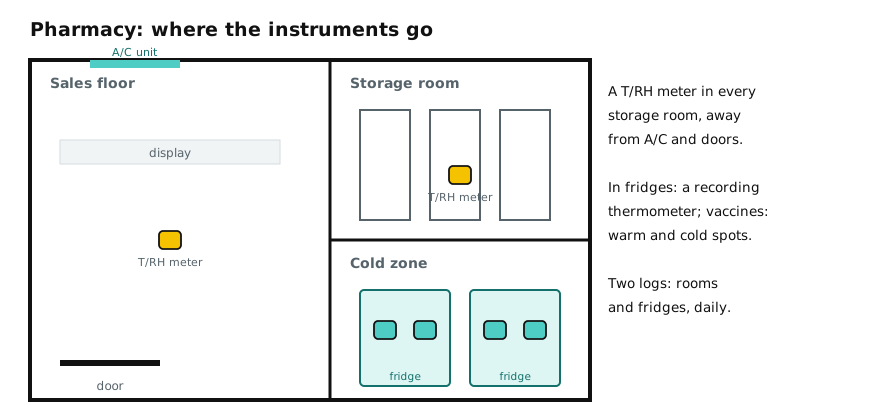
- A thermohygrometer in every storage room and zone, including the sales area if products are stored in its display cases.
- Not next to an air conditioner, the entrance door, a sun-facing wall or a heater — unless that specific risk zone is what needs to be monitored.
- At the height of the storage locations, not under the ceiling.
- A thermometer or sensor in every refrigerator; for immunobiological products, at the warmest and coldest points according to the temperature map, not on the door panel.
- All instruments must be measuring instruments with valid verification.
Logbooks
| Logbook | What to record | Frequency |
|---|---|---|
| Temperature and humidity log for premises | readings for each room or zone | daily, including weekends and public holidays (260n) |
| Temperature log for the inside of refrigeration equipment | readings for each refrigerator | daily |
| Temperature log for refrigerators with immunobiological products | thermometer and temperature indicator readings with numbers, power outages and breakdowns | twice a day (level 3 of the cold chain) |
| Record of receipt and dispensing of immunobiological products | lot, expiry date, temperature indicator readings | at each receipt and dispatch |
If the pharmacy is not open every day, only an automated system or a recording data logger can ensure daily records on days off. This is exactly why the Rules approved by Order No. 260n allow an automated round-the-clock monitoring system.
Refrigerators
- Use pharmaceutical refrigerators for thermolabile products, not household ones: they maintain a uniform temperature, have glass doors and protection against overcooling.
- Do not pack the refrigerator tightly: air must be able to circulate.
- Immunobiological products are not stored on the door panel or in an airflow colder than +2 °C.
- For immunobiological products, provide backup power or a procedure for moving them to a backup refrigerator and insulated containers.
Monitoring for a pharmacy and a pharmacy chain
A point-based Wi-Fi or GSM system covers all requirements with no cabling: a sensor in every room and refrigerator, electronic logbooks with no gaps, alerts to the pharmacy manager's phone when conditions go out of range, and, for a chain, a summary screen covering all pharmacies. Learn more in the industry solutions section.
Frequently asked questions
Is a pharmacy required to perform temperature mapping?
No, there is no direct obligation. What is mandatory is daily temperature and humidity control with records in a logbook. Refrigerators with immunobiological products require the manufacturer's temperature map or a temperature mapping report.
Can a pharmacy keep its temperature log electronically?
Yes. The Rules approved by Orders No. 259n and No. 260n allow electronic logbooks, including via an automated monitoring system with archiving.
What humidity is acceptable in a pharmacy?
By default, no more than 65 % under the Rules approved by Order No. 260n; for products labeled “store in a dry place,” no higher than 50 % under OFS.1.1.0010.
Who should record the temperature on weekends?
An employee authorized by the head of the organization. If the pharmacy is closed on weekends, data loggers or a monitoring system that record automatically are used.
Is an insulated container needed when selling a vaccine to a customer?
Yes. Under SanPiN 3.3686-21, retail dispensing of immunobiological products is allowed provided they are delivered to the place of use in an insulated container or thermos, the customer is instructed, and a note is made on the prescription.