Blood services: what Decree No. 641 requires
The Rules for the collection, storage, transportation and clinical use of donor blood and its components were approved by Decree of the Government of the Russian Federation No. 641 of 14 May 2025. They are in force from 1 September 2025 to 1 September 2031 and replaced Decree No. 797 of 22 June 2019. They are based on Federal Law No. 125-FZ of 20 July 2012 “On the Donation of Blood and Its Components”.
| Measuring instruments (clause 69) | temperature measuring instruments must be provided during storage and during transportation lasting more than 30 minutes |
| Recording during storage (clause 69) | the temperature is recorded at least twice a day |
| Recording during transportation (clause 69) | for transportation longer than 30 minutes — at the start of transportation and on arrival at the final destination |
| Conditions and shelf life | the storage temperature, transport temperature and shelf life of each component are given in Annex No. 3 to the Rules |
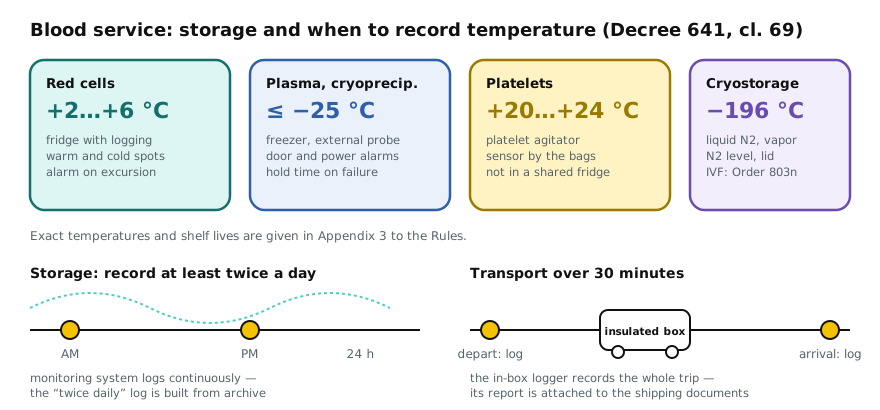
The “at least twice a day” requirement is the minimum for recording, not for monitoring. Twelve hours pass between two entries, and a refrigerator failure at night would be discovered in the morning — by which time the red cells would already have to be discarded. So we build monitoring this way: the system records continuously, the alarm goes out immediately, and the log with two entries a day is generated automatically from the archive.
How we build monitoring in a blood transfusion department
| Equipment | What we monitor | How |
|---|---|---|
| Refrigerators for red cell components | temperature at the warm and cold spots, door, power | two sensors positioned per the refrigerator’s temperature map (chamber mapping), a door-open sensor, 220 V power monitoring |
| Freezers for plasma and cryoprecipitate | temperature in the load volume, door, power, hold-over time on failure | remote probes in a product simulator so the alarm is not triggered each time the door is opened; qualification including a power-failure test |
| Platelet agitators and incubators | temperature next to the bags, whether agitation is running | a sensor next to the bags, power monitoring of the device |
| Transport and insulated containers | temperature in transit | Smartag data loggers in the container: the departure and arrival records come from the logger report, plus the full profile in between |
| Rooms | temperature and humidity in storage and dispatch areas | thermohygrometers, to separate a room problem from an equipment problem |
Alarms are escalated: first to the staff member on duty, after a set time to the head of department, then to the engineer. Channels include phone calls, SMS, a mobile app and a light-and-sound alarm unit in the department. During qualification, the hold-over time after a power cut is measured for each refrigerator, and it is used to set the threshold at which components must be moved to backup equipment.
IVF laboratories: Order No. 803n
The procedure for using assisted reproductive technologies was approved by Order of the Russian Ministry of Health No. 803n of 31 July 2020 (registered by the Ministry of Justice on 19 October 2020, No. 60457; in force since 1 January 2021). For the storage of biological material it establishes the following:
| clause 30 | cryopreservation and storage of germ cells, reproductive tissue and embryos are carried out by healthcare facilities licensed for the relevant work |
| clause 36 | cryopreserved biological material is stored in special labeled containers placed in liquid nitrogen or liquid nitrogen vapor |
| clause 37 | the healthcare facility is responsible for storage and for maintaining the cryopreservation conditions |
| clause 42 | logs of cryopreserved sperm, oocytes and embryos are kept using the forms in Annexes No. 6, 8 and 10 |
The Order does not specify a temperature threshold in the nitrogen vapor — this is set by internal procedures and by the Dewar manufacturer. Yet the responsibility under clause 37 is full, so monitoring is built with a safety margin:
- Liquid nitrogen level in each vessel — a level sensor or a temperature probe in the vapor at a set height; the alarm is raised well before the top canisters end up above the liquid nitrogen surface.
- Vapor temperature — a low-temperature probe (thermocouple or platinum sensor with a range down to −200 °C), recording to the archive, a trend chart for each vessel.
- Lid and access — an open-lid sensor so that prolonged opening is captured in the log.
- Incubators — temperature and CO₂; laboratory room — temperature and humidity; power — 220 V and UPS monitoring.
- 24/7 alarm escalation — embryologist, head of laboratory, engineer; an action plan involving a backup vessel and a nitrogen reserve.
The system records become an annex to the logs required by clause 42: each canister has a history of its storage conditions, and the facility has evidence of compliance with clause 37.
Documents the client receives
- Mapping report
For refrigerators, freezers and rooms — with temperature maps and the justification of sensor positions.
- Equipment qualification
IQ/OQ/PQ of refrigeration equipment and cryostorage, including a power-failure test and hold-over time.
- Schemes and SOPs
Sensor layout, alarm thresholds and routing, a deviation response procedure — in a format suitable for the transfusion committee and internal audit.
- Verification certificates
For all measuring instruments, with records in FSIS Arshin (Rosstandart’s verification database); look them up by number on the Verification Certificate page.
- Deviation reports
With start time, duration, actual temperature and staff actions — the basis for deciding whether a component is still usable.
Frequently asked questions
Is recording the temperature twice a day, as the Decree requires, enough?
Formally yes, but that is the minimum for the log. Blood components spoil within hours, while twelve hours pass between entries. Continuous monitoring with alarms does not replace the requirement — it fulfills it automatically and adds what matters most: time to react.
Does a medical refrigerator need to be mapped?
Yes, if decisions on whether components are usable rely on its readings. Chamber mapping shows the warm and cold spots and the areas where overheating near the door or overcooling near the evaporator can occur. Based on the results, sensors are placed where they truly represent the whole volume.
How should Dewar vessels be monitored if Order No. 803n does not set a temperature?
Monitor what their integrity depends on: the nitrogen level and the vapor temperature at the height of the top canisters, the lid, the power supply. Thresholds are set by the facility’s procedures, taking into account the vessel manufacturer’s recommendations; the system records compliance with them and keeps a history for each vessel.
How do we meet the requirement for recording during transportation?
The data logger in the insulated container is started before departure and stopped on arrival: the first and last entries of its report are the “at the start and on arrival” records. In between is the full profile, which shows whether there were any excursions in transit.