How a cold room differs from a warehouse
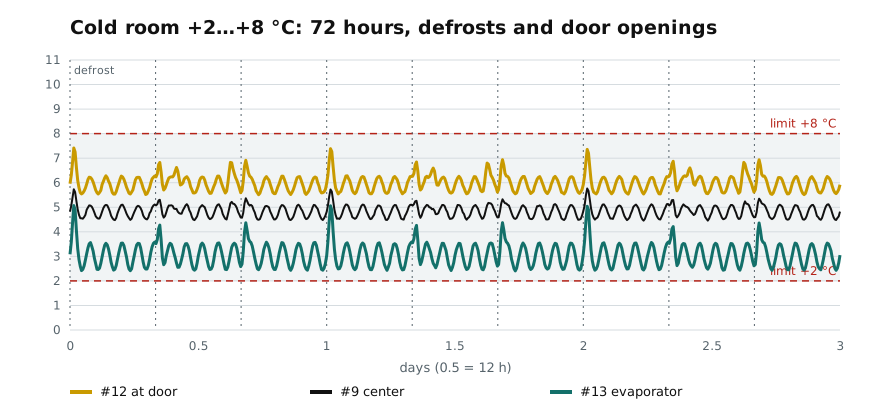
In a cold room, a small volume is cooled by a powerful air flow from the evaporator. This gives it its specific features: a steep gradient between the cold air outlet and the far corners, compressor cycles with an amplitude of tenths of a degree, periodic defrosts and rapid warming when the door is open. For thermolabile products, not only heat is dangerous but also overcooling: vaccines, insulins and many biologics lose potency when frozen.
That is why, for cold rooms and freezer rooms that are not critically affected by daily and seasonal fluctuations, the EEC guideline allows a study duration of 24 to 72 hours instead of a week. If the cold room is located inside controlled-environment premises, separate summer and winter studies are generally not required. For cold rooms along exterior walls, in unheated annexes or on a loading dock, it is better to take seasonality into account.
Logger layout
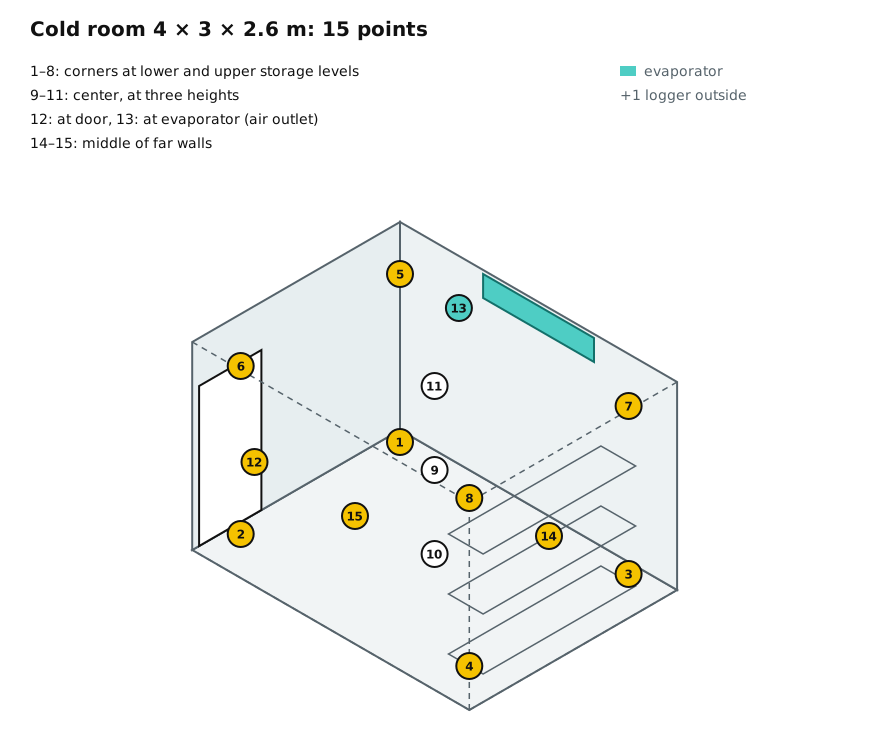
Industry practice (ISPE and WHO guidance) and the EEC grid agree on the basic principle: loggers cover the storage volume along its length, width and height. For a cold room, this means the corners at the lowest and highest storage levels, the center of the volume and the risk points.
| Volume or type | Typical number of points | Comment |
|---|---|---|
| Pharmaceutical refrigerator up to 2 m³ | 9 | 8 corners of the usable volume and the center |
| Cabinet of 2–20 m³, small cold room | 12–15 | add the door, air outlet and middle of the shelves |
| Cold room of 20–100 m³ | 15–27 | grid along length and width, 2 levels in height |
| Cold room over 100 m³ and high racking | per EEC grid | 3 levels for a storage height of 5 m or more |
The EEC guideline does not apply to household refrigerators and small equipment; their suitability is confirmed separately under national rules. In practice, pharmacy and medical refrigerators are still checked using the same logic: corners, center, door.
Tests we include
Steady-state operation
The cold room runs in normal mode with the door closed. We determine the actual range at each point, the amplitude of compressor cycles, the effect of defrosts and the mean temperature per point. According to the EEC guideline, it is the mean values that best reveal the true hot and cold spots.
Door opening
We simulate real-life operation: a predefined frequency and duration of door openings, for example three openings of 60 seconds each. The parameters are recorded in the study method and taken into account in the acceptance criteria. The result is the recovery time and the depth of warming near the door.
Power failure
We switch off the refrigeration unit and record how many minutes it takes for the first point to exceed +8 °C. This figure is needed for the emergency action plan: how much time the person on duty has to move the products or start backup cooling.
Backup unit
If the cold room has a redundant refrigeration unit, we monitor both units at the same intervals to confirm that the backup holds the temperature range.
Acceptance criteria
| Criterion | Example value |
|---|---|
| All points within range with the door closed | +2.0…+8.0 °C |
| Recovery time after door opening | no more than 15 min (set in the protocol) |
| Time to exceed +8 °C after power failure | recorded and used in the emergency plan |
| Difference in mean values between points | assessed; stable zones are marked in the report |
| Logger accuracy | ±0.5 °C or better, valid verification |
Practical recommendations for cold rooms
- Do not place products right against the evaporator or in the path of the outgoing air, as there is a risk of freezing.
- Leave a gap between products and walls, and keep free air circulation space under the ceiling.
- The monitoring sensor is positioned based on the mapping results: most often at the warmest spot where products are stored, with a second sensor at the cold spot if there is a risk of freezing.
- The refrigeration unit’s control sensor and the monitoring sensor are different devices with different purposes.
- After evaporator repair, unit replacement or rearrangement of shelving, the cold room is re-mapped.
Frequently asked questions
How many hours does cold room mapping take?
The EEC guideline allows 24 to 72 hours, and longer if necessary. We usually plan for 48–72 hours so that the data includes several defrost cycles and a working day with door openings.
How many loggers are needed for a refrigerator?
A pharmaceutical refrigerator of up to 2 m³ usually needs 9 points (the corners and the center). For cold rooms, the number grows with the volume: 15 or more, and large rooms use the EEC grid based on length, width and height.
Does a cold room need to be mapped in summer and winter?
If the cold room is located inside controlled-environment premises, generally not. If it borders the outdoors or stands in an unheated room, it is better to check the seasonal effect.
Why run a power-failure test?
It shows how many minutes the cold room holds +2…+8 °C without power. This figure is the basis for the emergency action plan and for alarm settings.
Where should the monitoring sensor go after mapping?
At the point that the study showed to be closest to the limit and where products are stored. If there is a risk of freezing near the evaporator, a second sensor is added at the cold spot.
Do the results change if the setpoint is changed?
The EEC guideline allows changes to refrigeration equipment settings within the storage range without re-mapping. Replacing the unit or rebuilding the cold room calls for a new study.
Can a cold room be mapped with products inside?
Yes, this is mapping under operating conditions. Loggers are placed between packages without opening them and without touching metal shelves.