Why transport is qualified separately
The EEC guideline on temperature mapping explicitly leaves mobile cold chain equipment outside the scope of its methodology: these matters are governed by national legislation. At the same time, the EAEU Good Distribution Practice Rules require that the storage conditions of medicinal products be maintained during transportation as well, and that temperature control equipment in vehicles be in good working order and metrologically supported. For immunobiological medicinal products, the sanitary rules SanPiN 3.3686-21 and the methodological guidelines MU 3.3.2.3970-23 on temperature control at all levels of the cold chain apply.
In practice this means the shipper must have evidence that a specific vehicle or packaging system maintains the required conditions. That evidence is the qualification protocol and report.
Active transport: refrigerated trucks and vans
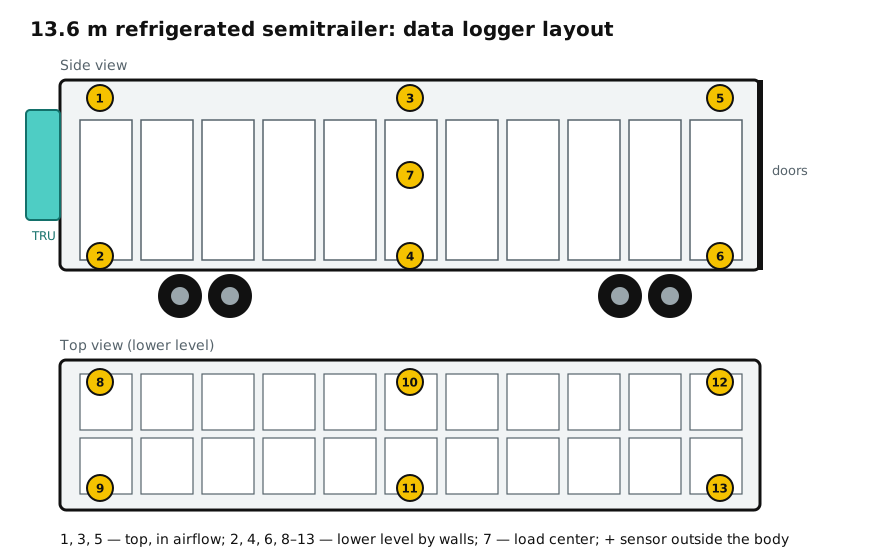
In a body fitted with a refrigeration and heating unit, air flows from the unit under the ceiling toward the doors and returns along the floor. In summer the warmest spots are near the doors and under the roof; in winter the coldest are near the walls and floor, where the heated air does not reach. In +2…+8 °C mode, the upper layer of cargo near the unit is at risk of overcooling.
| Test | What it shows |
|---|---|
| Pre-cooling of the empty body | how many minutes it takes for the space to reach the set range before loading |
| Empty body, steady state | temperature distribution and unit performance without the influence of cargo |
| Loaded body (simulated load) | actual hot and cold spots between pallets |
| Door openings | warm-up and recovery time during typical delivery stops |
| Unit shutdown | time until limits are exceeded — the basis of the driver's emergency instructions |
| Summer and winter studies | cooling performance in the heat and heating performance in frost |
For testing we use Smartag temperature indicators of a single type. The test duration is tied to the longest route or driver shift, and the logging interval is 1–5 minutes so that door openings are visible. A logger outside the body records the ambient temperature — without this data, the results cannot be compared.
Passive packaging: insulated containers
An insulated container with coolant packs does not regulate temperature; it only slowly loses ground. It is therefore qualified by its hold time under a defined ambient temperature profile. International practice uses the profiles of the ISTA 7D and 7E standards; for Russia, it is better to build the profile from real data on your own routes, including winter ones.
- pack-out configuration: number and conditioning temperature of coolant packs, spacers, cargo arrangement;
- minimum and maximum load — an empty container warms up and cools down faster;
- summer and winter profiles, including time spent in warehouses and in vehicles;
- data loggers at the corners of the load, next to the coolant packs and in the center;
- outcome — a confirmed hold time for each configuration and pack-out instructions.
Freezing is a common hidden problem. Coolant packs taken straight from a freezer at −20 °C and placed directly against vaccines can freeze them within a few hours. Conditioning of coolant packs and a freeze indicator are a mandatory part of any pack-out for +2…+8 °C.
Immunobiological medicinal products
Immunobiological medicinal products (vaccines) are handled through a multi-level cold chain, from the manufacturer to the vaccination room. SanPiN 3.3686-21 requires temperature monitoring during storage and transportation, the use of insulated containers and temperature indicators, recording of their readings on receipt and dispatch, and an emergency plan at every level. The methodological guidelines MU 3.3.2.3970-23 describe in detail how to use temperature indicators and data loggers. For insulated containers we use Smartag mini with a light signal for excursions. Learn more on the page about choosing temperature indicators.
Food products
The same methodology applies to the transport of perishable food. International carriage is governed by the Agreement on the International Carriage of Perishable Foodstuffs (ATP), which defines the classes of insulated bodies and the procedure for testing them at accredited test stations. Mapping a vehicle body does not replace an ATP certificate, but it shows how the vehicle performs with a specific load.
Qualification deliverables
- a report with the logger layout, graphs and a conclusion for each scenario;
- loading rules: clearances from the walls and the unit, prohibited areas of the body;
- pre-cooling time and maximum door-open duration;
- a location for the permanent monitoring sensor and alarm settings;
- emergency instructions with a confirmed hold time.
Frequently asked questions
Is refrigerated truck qualification mandatory for transporting medicines?
Russian regulations contain no direct requirement to “map every vehicle”, but EAEU GDP requires that storage conditions be maintained during transportation and that this be demonstrated. Qualification is the standard way to provide that evidence, and manufacturers and distributors request it when auditing a carrier.
How many data loggers are placed in a refrigerated truck?
Typically 9 points for a van and 13–15 for a semi-trailer: top and bottom near the unit, in the middle and near the doors, in the center of the load, plus a sensor outside.
How does insulated container qualification differ from refrigerated truck qualification?
A container does not regulate temperature, so what is determined is its hold time under a defined ambient temperature profile, and the pack-out configuration is fixed.
Does qualification need to be repeated?
Yes: after replacement or repair of the refrigeration unit, modification of the body, a change in the loading pattern or packaging, in case of recurring deviations, and on a schedule set by risk assessment.
Are temperature indicators needed if the vehicle has a monitoring system?
For vaccines in insulated containers, temperature indicators are required by the sanitary rules. For other cargo, an indicator remains useful independent evidence for the consignee.