What the system does
The storage rules of Order No. 260n require temperature and humidity to be checked daily, including weekends and public holidays, while SanPiN 3.3686-21 requires values for immunobiological medicinal products to be recorded at least once a minute and the data to be kept for five years. This cannot be done manually at night and on weekends, and a paper log cannot tell you what happened between two entries. The Hladverk Group monitoring system does it automatically:
- measures parameters at points selected on the basis of temperature mapping results;
- maintains a secure electronic archive and a user activity log;
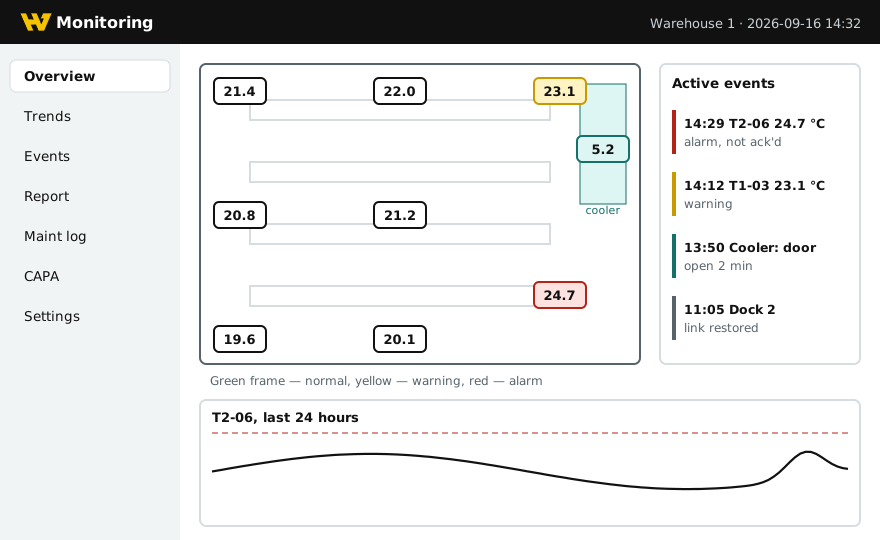
- reports a deviation within minutes and escalates the alarm until it is acknowledged;
- generates logs and reports for Roszdravnadzor inspections and distributor audits;
- records deviation investigations and corrective actions in the same system.
System architectures
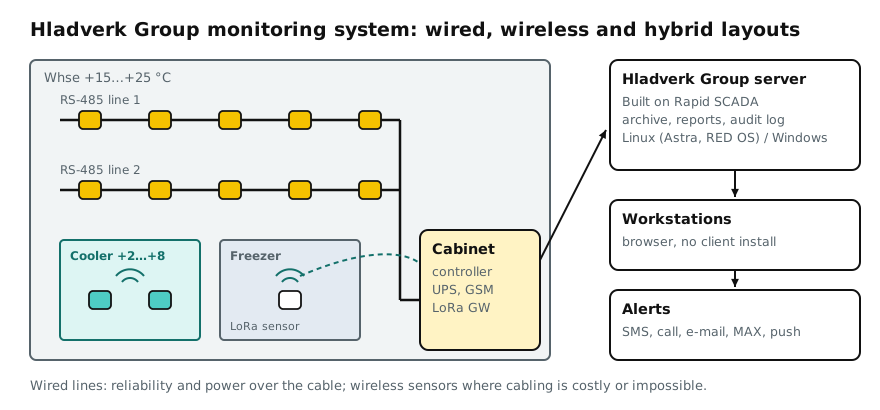
| Architecture | When to choose it | Advantages | Limitations |
|---|---|---|---|
| Wired (RS-485, Ethernet) | new and large warehouses, production sites, sites with strong interference | power over cable with no batteries, high reliability, long lines | longer installation, cable routes required |
| Wireless (LoRa) | operating warehouses, cold rooms, sites where cabling is not possible | fast installation, long radio range, several years of battery life | batteries need replacing, reinforced concrete reduces range |
| Hybrid | complex sites: a warehouse with cold rooms, several buildings | best balance of cost and reliability | radio coverage has to be designed |
| Point-based (Wi-Fi, GSM) | pharmacies, vaccination rooms, individual refrigerators, laboratories | minimal hardware, up and running in a day | depends on Wi-Fi or cellular coverage |
We choose the architecture after a site survey: we look at the layout, wall and floor materials, existing cable routes, redundancy requirements and the customer’s IT policy — whether an on-premises server is needed or the cloud is acceptable.
System components
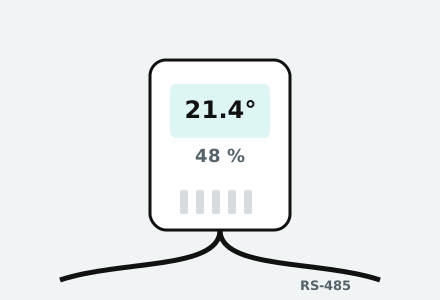 Wired sensorsthermohygrometers and remote probes for cold rooms and freezers
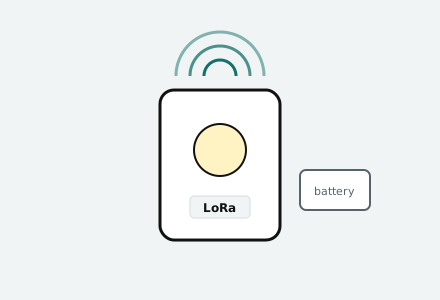 Wireless sensorsLoRa and Wi-Fi, battery-powered, with data buffering
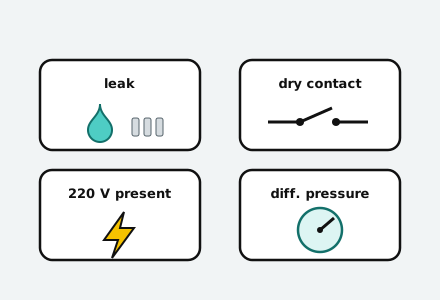 Alarm and pressure sensorswater leak, dry contact, 220 V presence, differential pressure, particle counter
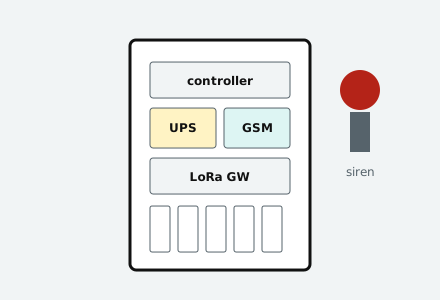 Control cabinetcontroller, UPS, GSM module, gateway, light and sound alarms
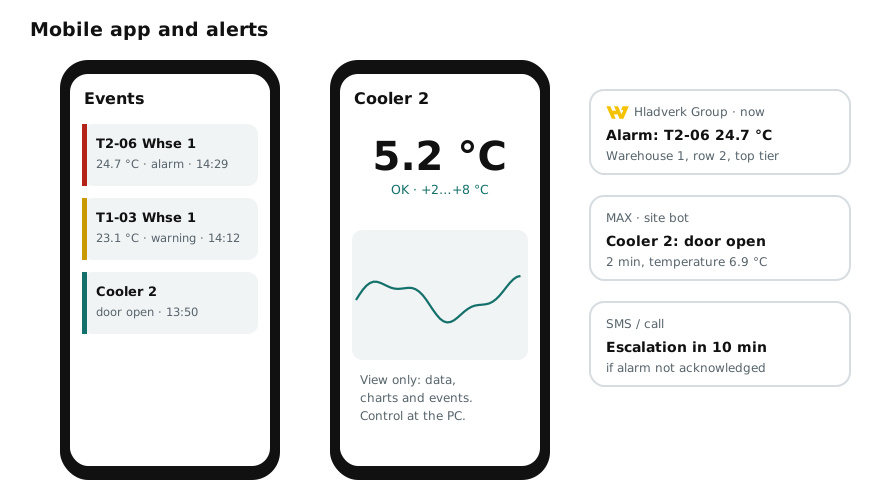 Software and mobile appweb interface, reports, maintenance log, CAPA, push and MAX
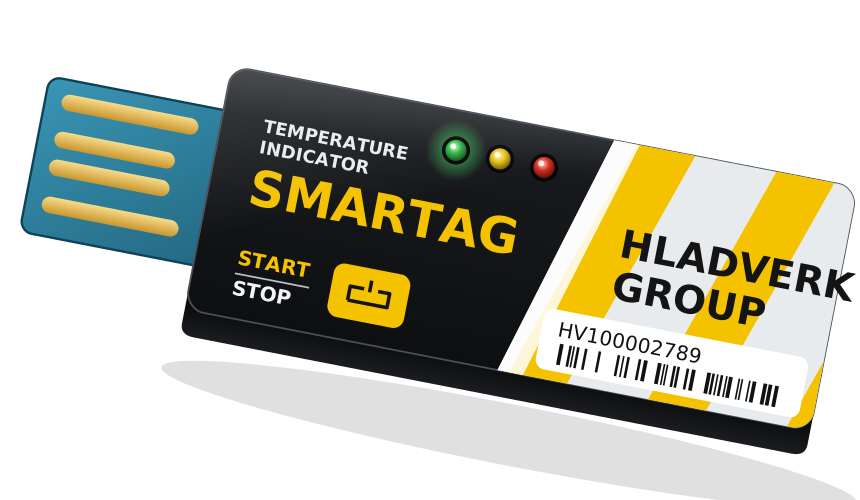 Smartag and Smartag Zondour temperature indicators for mapping and a probe with an I2C interface
System specifications
| Measured parameters | air and product temperature, relative humidity, atmospheric and differential pressure, CO₂; discrete signals: door, refrigeration unit failure, power supply |
| Temperature ranges | versions for warehouses and cold rooms, freezers at −40…−20 °C and ultra-low temperatures down to −80 °C (remote probes) |
| Accuracy | temperature — down to ±0.5 °C within the operating range; humidity — as per the type description of the selected measuring instrument |
| Metrology | approved-type measuring instruments only, supplied with verification; records in FSIS Arshin |
| Measurement interval | configurable; at least once a minute for the cold chain of immunobiological medicinal products |
| Interfaces | RS-485 (Modbus RTU), Ethernet (Modbus TCP), LoRa, Wi-Fi, GSM/LTE |
| Autonomy | UPS in the control cabinet; data buffering in the controller and sensors when the connection is lost |
| Scale | from a single point to thousands of sensors across distributed sites |
| Server side | customer’s on-premises server or cloud hosting; Windows or Linux, including Astra Linux and RED OS |
| Access | web interface with no client software to install, role-based access |
| Alerts | SMS, voice call, e-mail, MAX, push notifications in the mobile app, light and sound alarms, display boards |
| Archive | immutable raw data, audit trail, backups; retention period per SOP (at least 5 years for immunobiological medicinal products) |
Regulatory compliance
| Requirement | How it is met |
|---|---|
| Daily monitoring of T and RH, including weekends (260n, clause 18) | continuous automatic recording and an electronic log with archiving |
| Monitoring devices placed according to mapping (260n, clause 18; EAEU GDP) | sensor locations are taken from the mapping report; if needed, we carry out the mapping ourselves |
| Verified measuring instruments (260n, clause 11; Federal Law 102-FZ) | approved-type sensors with verification, a verification schedule and a pool of replacement sensors |
| For immunobiological products: recording at least once a minute, ±0.5 °C accuracy, 5-year retention, protection against falsification (SanPiN 3.3686-21) | interval configuration, immutable archive, audit trail |
| Temperature alarms for cold rooms storing immunobiological products (SanPiN 3.3686-21) | alarms in the software and light and sound alarms on site |
| Validation of computerized systems (EAEU GDP, GAMP 5) | IQ, OQ, PQ documentation and testing package — system validation |
Implementation process
- Survey and questionnaire
Sites, zones and conditions, number of points, existing networks and servers, requirements for alerts and reports.
- Design
Sensor layout based on mapping results, cable routes or radio coverage, equipment specification, software structure and roles.
- Supply and installation
Installation of sensors, lines and the control cabinet, connection to the network and backup power.
- Software configuration
Site mimic diagrams, alarm thresholds and delays, recipients and escalation, log and report templates.
- Validation and training
Testing according to protocols, verification of alarms and the archive, staff training, handover of documentation.
- Ongoing support
Scheduled verification, maintenance, updates and remote support.
Frequently asked questions
Is the system suitable for a pharmacy with two refrigerators?
Yes. For small sites we use a point-based Wi-Fi or GSM setup: a few verified sensors, a cloud or on-premises server, and alerts sent to the responsible person’s phone.
Can sensors that are already installed be used?
If they are approved-type measuring instruments with a digital interface (Modbus, for example), they can be connected to the system. We decide after reviewing their documentation and verification status.
What happens if power or the internet goes down?
The control cabinet runs on a UPS, and the controller and sensors buffer data and transmit it once the connection is restored. The system sends a technical alarm about the loss of connection via the GSM channel.
Where is the data stored?
At the customer’s choice: on a server in the customer’s own infrastructure or in the cloud. For organizations required to use domestic software, the server is deployed on Astra Linux or RED OS.
Does the system need to be validated?
For manufacturers and distributors of medicinal products — yes: computerized systems that affect quality must be validated before being put into operation. We carry out validation as part of the implementation.
How much does a monitoring system cost?
It depends on the number of points, the communication architecture, server-side requirements and validation. Send us the site plan and a list of zones, and we will prepare a specification and a cost estimate.