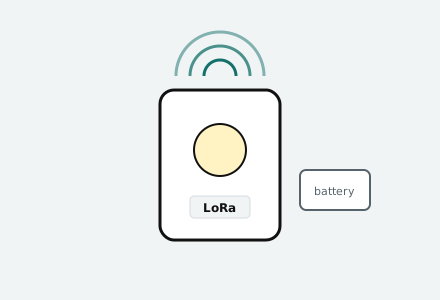
Technology comparison
| LoRa | Wi-Fi | GSM/LTE | |
|---|---|---|---|
| Range | hundreds of meters in a fully loaded warehouse, kilometers in open terrain | tens of meters to the access point | anywhere with cellular coverage |
| Batteries | up to several years depending on the transmission interval | months; external power for continuous operation | months with frequent transmission |
| Infrastructure | LoRa gateway in the control cabinet | customer's Wi-Fi network | SIM card, no site network needed |
| Interference | robust, but reinforced concrete reduces range | depends on network load | depends on coverage; weak signal inside cold rooms |
| Typical use | warehouses, cold rooms, buildings | pharmacies, laboratories, vaccination rooms | remote sites, refrigerated trucks |
Typical specifications
| Parameters | temperature; temperature and humidity; probe for cold rooms and freezers |
| Temperature accuracy | down to ±0.5 °C |
| Measurement and transmission interval | configurable; for vaccines, measurement at least once per minute with buffering |
| Internal memory | stores measurements while the connection is lost and uploads them once it is restored |
| Display | current values and connection status (depending on the model) |
| Mounting | wall, magnets, racking |
| Verification interval | as per the type description, usually 1–2 years |
How we design the radio network
- Radio survey
We measure signal strength at the installation points in a fully loaded facility: an empty warehouse gives an overly optimistic picture.
- Placement of gateways and repeaters
With a signal strength margin, so that rearranging the racking does not break the connection.
- Battery life calculation
Based on the measurement and transmission intervals; the battery replacement schedule is entered in the maintenance log.
- Commissioning check
A test of connection loss and buffer upload is part of OQ testing.
The metal walls of a cold room shield the radio signal. For cold rooms we use sensors with a remote probe: the radio module stays outside and only a thin cable enters the room.
Frequently asked questions
How long does a wireless sensor battery last?
It depends on the transmission interval, temperature and link quality. For LoRa sensors with infrequent transmission it is several years; with frequent transmission it is less. We calculate battery life at the design stage.
Will data be lost if the connection fails?
Sensors with internal memory store measurements and transmit them once the connection is restored; the system logs a technical event for the connection loss.
Can wired and wireless sensors be combined?
Yes, this is a hybrid setup: everything is brought together in one control cabinet and one software package.